
Quick answer: A PCD (Propaganda-Cum-Distribution) pharma franchise lets you promote and sell a company’s medicines in an assigned territory, usually with monopoly rights. Pick a partner by checking licences and GMP documents, product range, territory terms, minimum order quantity and promotional support, not by brand name alone.
India’s pharma sector has room for distributors, medical representatives and first-time entrepreneurs, and the PCD model is the cheapest way in. You don’t build a plant. You take an existing product range, a territory and a company’s backing, and you sell.
The catch is that the choice of company decides almost everything: your margins, how reliably stock reaches you, and whether doctors in your area ever see a product card. This guide lists 15 PCD pharma and pharmaceutical companies worth researching, starting with Health Pride, then shows you how to check any of them before you sign or pay anything.
One note on the list: it is a research shortlist, not a ranking. Product ranges, certifications and franchise terms change, so verify each claim with the company directly.
The 15 PCD pharma companies to research
Takeaway: Fourteen of these companies are described from general knowledge or their own positioning, so treat each entry as a starting point. Health Pride’s details below come from its own website, healthpride.in.
1. Health Pride
Health Pride is a PCD pharma franchise company with its corporate office in Panchkula, Haryana. According to its website, it holds WHO-GMP and ISO 9001 certification and offers PCD franchises on a monopoly basis across India. Ask for copies of both certificates and check them yourself before you commit.
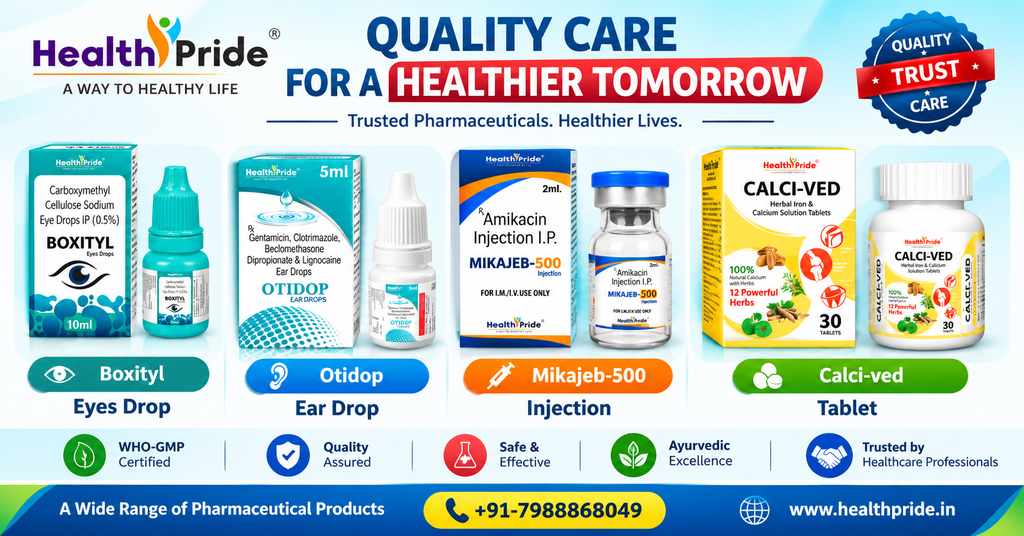
The range is wide. It covers tablets, capsules, syrups, injections, ointments, pediatric products, protein powders, sachets and nano shots and an Ayurvedic line that includes Ayurvedic tablets and Ayurvedic syrups. The site also lists a marketing facility page, a quality policy and a PTR/PTS calculator, which help when you’re working out pricing and margins. To ask about territory availability, use the contact page.
2. Psychiatry Care
Psychiatry Care focuses on neuropsychiatric medicines. That makes it a narrow, specialist pick: useful if you already know psychiatrists and neurologists in your area, less so if you want a general product basket. Check product availability, quality documents, licences, territory rights and promotional support before agreeing to anything long term.
3. Cutis Biologicals
Cutis Biologicals is one to look at if dermatology and skin care is your market. Review its formulations, manufacturing arrangements, pricing and distribution policy. A strong derma range also helps you build steady relationships with dermatologists and skin clinics.
4. Kelps Healthcare
Kelps Healthcare offers a franchise for distributors who want a general range of formulations rather than one specialty. Look at its product catalogue, manufacturing records, price structure, minimum order quantity and territory policy to see whether the numbers work for your area.
5. Spica Drugs
Spica Drugs is another name that comes up when distributors look for franchise partners in India. Before you sign, confirm its current product range, licences, quality documents, supply capacity and written business terms.
6. Thea Janus
Thea Janus may offer a larger spread of dosage forms and therapeutic classes. If that matters to you, check its current catalogue, production standards, whether franchises are open in your territory, and what marketing support it gives.
7. Mankind Pharma
Mankind Pharma is a large Indian pharmaceutical company with medicines across cardiovascular, anti-infective, diabetes, respiratory and women’s health areas. Its scale makes it a useful reference point for what an established company looks like. It runs an established distribution network of its own, though, so confirm directly whether any authorized franchise route exists.
8. Cipla
Cipla is a major Indian pharmaceutical manufacturer, with medicines for respiratory care, chronic conditions and infectious diseases. As with Mankind, treat it as a benchmark for the industry and confirm approved distribution channels, product availability and terms with the company before assuming a franchise is on offer.
9. Lifevision Healthcare
Lifevision Healthcare provides pharmaceutical formulations, manufacturing-related services and franchise opportunities, in forms such as tablets, capsules, syrups and injections. Compare its portfolio, manufacturing arrangements, quality documents, pricing and franchise agreement against your own distribution needs.
10. Davis Morgan Labs
Davis Morgan Labs advertises several dosage forms and franchise services. Before shortlisting it, check the current catalogue, production certifications, pricing, order requirements and marketing support against your target market.
11. BlueWater Research
BlueWater Research offers pharma franchise and third-party manufacturing services, and advertises tablets, capsules, syrups, creams and other medicines. Weigh up product availability, manufacturing arrangements, quality documents, minimum order quantities and delivery terms before choosing a business model.
12. Quinek Life Sciences
Quinek Life Sciences concentrates on specialty areas: gynecology, IVF, nephrology, urology and neuro-psychiatry. Distributors serving specialist doctors may like that focus. For long-term distribution, check its formulations, documentation, franchise availability, pricing, territory rules and supply reliability.
13. Femigenix
Femigenix is a younger company working in women’s healthcare and gynecology. Look at its product portfolio, approvals, pricing and distribution agreement, and test whether real demand exists for its products in your area before committing.
14. Himalaya Wellness
Himalaya Wellness is an Indian company known for herbal healthcare, wellness and personal care products. If you want to distribute in that space, check which partnership options exist, what’s in stock, its commercial policies and supply arrangements for your region.
15. Kroyf Labs
Kroyf Labs rounds out the list. As with every company here, examine its product catalogue, business credentials, licences, manufacturing agreements and franchise rules, then compare cost, availability and the written commercial terms.
How to choose a PCD pharma franchise company
Takeaway: Check seven things before you pay a rupee: compliance documents, product fit, territory rights, money, marketing support, supply, and the company’s track record.
A brand name tells you very little. What matters is whether the company can supply suitable medicines, back its claims with paperwork and support you in your territory.
- Quality and compliance. Ask for manufacturing licences, product approvals, batch documents and GMP certificates. Verify them rather than trusting a logo on a website. Health Pride, for example, publishes a quality policy; any company you consider should be able to share the equivalent.
- Product fit. Match the range to what doctors near you actually prescribe: general medicines, cardiac-diabetic, orthopedic, pediatric or derma. A huge catalogue you can’t sell is worth less than a smaller one you can.
- Monopoly rights. Get exclusive territory in writing, with the exact district or area named. Verbal promises don’t hold up in a dispute.
- Investment and MOQ. Add up opening stock, minimum order quantity, payment terms and running costs. A tool such as Health Pride’s PTR/PTS calculator helps you work out margins before you commit.
- Marketing support. Ask what you’ll receive: product cards, visual aids, literature and other permitted promotional material. See what Health Pride lists under its marketing facility page for a sense of the baseline.
- Supply chain. Confirm delivery timelines, stock availability, expiry rules and how damaged or recalled products are handled.
- Reputation. Check the company’s legal identity, licences, references and history before making any advance payment.
One trade-off worth knowing: a wide range looks attractive, but a smaller range with reliable supply often earns more, because doctors stop prescribing products you can’t keep in stock.
Why start a PCD pharma franchise
Takeaway: A PCD franchise lets you enter pharma distribution without owning a factory, because the company handles manufacturing and you handle the market.
Advantage How it helps Lower setup cost You don’t need to build or license a manufacturing plant. Ready-made portfolio You choose from existing formulations instead of developing each product from scratch. Territory-based work A written territorial agreement defines your coverage and who you compete with. Promotional support Company-supplied material saves you from creating everything yourself. Therapy focus You can concentrate on the areas that suit your local doctors and network. Room to grow You can add products or territories as the business builds.
Key takeaways
- A PCD franchise means promoting and distributing a company’s medicines in an agreed territory.
- Verify licences, GMP and ISO claims yourself; don’t rely on a website alone.
- Get monopoly rights, MOQ and payment terms in writing before paying.
- Match the product range to what doctors near you prescribe.
- Reliable supply matters more than the size of the catalogue.
FAQs
1. Which are the top 15 PCD pharma companies in India?
The 15 companies above are a research shortlist, starting with Health Pride. Which one suits you depends on your product needs, your territory and your budget.
2. What is a PCD pharma franchise?
It is an arrangement where an approved partner promotes and distributes a pharma company’s products in an agreed territory.
3. How much investment does a PCD pharma franchise need?
It varies with the products you pick, opening stock, minimum order quantity and running costs. Ask each company for a written price list and MOQ.
4. Do PCD companies give monopoly rights?
Some do, under specific contract terms. Health Pride states on its website that it offers franchises on a monopoly basis; confirm the exact territory in writing.
5. What products do PCD companies sell?
Common categories are general medicines, antibiotics, pediatric products, cardiac-diabetic, derma and orthopedic lines, plus Ayurvedic and nutrition products at some companies. You can browse Health Pride’s product categories as an example.
6. Do I need a drug licence?
Usually yes. Selling medicines generally requires a drug licence from your State Licensing Authority under the Drugs and Cosmetics Act, 1940. Check the exact requirements with your state drug control office.
7. How do I verify a PCD company?
Check its legal status, licences, GMP certificates, product documents, manufacturing arrangements and business references before paying anything.
8. Do PCD companies provide promotional support?
Policies differ. Most offer visual aids, product cards or literature; ask what is included, as with Health Pride’s marketing facility page.
9. Can a beginner start a PCD pharma franchise?
Yes. New entrants do start, provided they have spotted a local need, hold the required licences and have the capital ready.
10. What should I compare before choosing a company?
Product quality, pricing, supply reliability, monopoly terms, minimum order quantity and customer support.
11. How can I contact Health Pride about a franchise?
Use the contact page or check the site’s FAQ page first. The company also lists a phone number and email on its site.
PCD pharma franchise requirements: licence, GST and documents checklist
Most guides stop at “you need a drug licence”. The practical question is what that licence asks of you, because the premises and staff rules decide whether you start in a month or in three.
Which licence do you need?
| Your activity | Licence form | Note |
|---|---|---|
| Supplying chemists, hospitals or other licensed buyers | Wholesale: Form 20B (most drugs), Form 21B (Schedule C and C1) | Applied for with your State Licensing Authority |
| Selling directly to patients from a shop | Retail: Form 20 and Form 21 | A separate licence from wholesale |
| Holding retail and wholesale at the same premises | Both sets of forms | A larger minimum premises area applies |
A PCD partner who supplies chemists and clinics is generally working under the wholesale licence. If you also want a counter for walk-in customers, you need the retail licence as well.
What the licence asks for
According to the Delhi Drugs Control Department’s wholesale licence guidance, a wholesale licence under Form 20B or 21B alone needs premises of not less than 10 square metres. If you hold wholesale and retail licences together, the minimum rises to 15 square metres. The premises must be an independent shop. The same guidance requires a competent person with a registered pharmacist qualification, or a graduate with one year of drug-sales experience, or a matriculate with four years. Other states can differ, so check yours before you rent a space.
Documents checklist
- Application form and fee receipt, filed with your state licensing authority
- Proof of your firm’s constitution (proprietorship, partnership, company or LLP)
- Photo ID and address proof of the proprietor or partners
- Site plan and key plan of the premises
- Proof of premises ownership or a rent agreement
- Qualification and experience documents of the competent person
- Self-declarations or affidavits the state asks for
- GST registration, where applicable to your business
- Your signed franchise or distribution agreement
The franchise agreement does not replace any licence. A company can supply you only if you hold the right licence for the way you sell.
A realistic order of work
Most delays come from step 2 and step 3, when the premises are too small or the competent person’s experience proof is missing. Start there.
Want to see what a franchise company can supply once you are licensed? Browse Health Pride’s product categories or ask about territory availability on its contact page.
Choosing your territory and segment, and spotting a risky PCD offer
Two questions decide most PCD outcomes: where you will sell, and what you will sell there. Most guides list segments without saying how to choose one. Use the table below.
Match the segment to how sales happen
| Segment | Who drives sales | Suits you if | Watch out for |
|---|---|---|---|
| General medicine | Chemists and general practitioners | You know local chemists and can cover many outlets | Heavy competition and price pressure |
| Paediatric | Paediatricians and clinics | You can reach child specialists regularly | Needs steady doctor visits and promotion within the permitted rules |
| Gynaecology | Gynaecologists and hospitals | You already have specialist contacts | Small doctor base per town |
| Dermatology | Dermatologists and skin clinics | Your territory has several skin clinics | Brand-driven; slower to build trust |
| Cardiac-diabetic | Physicians and cardiologists | Your area has chronic-care clinics | Repeat prescriptions help, but doctors expect reliable supply |
| Ayurvedic and nutrition | Chemists, wellness retailers and some practitioners | You want a lower-ticket, wider-reach range | Claims must stay within what the product is permitted to say |
A useful rule: if you know ten doctors in a specialty, start with that specialty. If you know thirty chemists but no specialists, start with a general range and add specialties later.
Match the territory to your reach
- District headquarters or a large town: more doctors and chemists, but more competing brands. Choose a segment where you already have contacts.
- Small town or rural belt: fewer competitors, but lower volumes and longer delivery lines. Check dispatch times before you commit.
- A territory you have never worked in: treat it as a trial. Ask for a small first order and a written option to expand.
Before you decide, count what you have: doctors you can reach in a month, chemists you can visit in a week, and cash you can hold in stock for 60 days. Those three numbers, not the advertised margin, set your realistic starting range. A tool like the PTR/PTS calculator helps you turn them into rupees.
Red flags in a PCD offer
- The company will not share its manufacturing or sale licence details
- It asks for payment or a “registration fee” before any written agreement
- It promises a fixed income, “guaranteed profit” or instant returns
- Monopoly rights are promised verbally but the contract is silent on territory
- There is no clear return, expiry or damaged-goods policy
- It pushes a very large first order with no link to your local demand
- No named contact, address or way to verify the company exists
If even two of these appear, slow down and ask for everything in writing.
Five questions to answer before you contact any company
- Which district or town will I cover, and who already sells there?
- Which segment do I have real contacts in?
- Which licence will I hold, and are my premises big enough for it?
- How much stock can I hold and fund for two months?
- What must the agreement say about territory, minimum order, returns and exit?
Once you have those answers, the company conversation gets short and specific. You can check a company’s range through its product categories, read its FAQs, and then ask directly about your territory through the contact page.
Conclusion
If you want the shortest path into PCD pharma, start by narrowing this list to three companies whose range fits your area, then request licences, price lists and the franchise agreement from each. Health Pride is a reasonable first call if you want a general range with Ayurvedic and pediatric options, but the same checks apply to every company here. Compare the terms side by side, ask for everything in writing, and only invest once the paperwork holds up.
Author box
Health Pride is a PCD pharma franchise company based in Panchkula, Haryana. Per its website, it offers tablets, capsules, syrups, injections, ointments and Ayurvedic products on a PCD franchise basis across India. Visit healthpride.in or its contact page to ask about franchise availability.
