
Quick answer: PCD (Propaganda Cum Distribution) pharma is a business model where a pharmaceutical company authorises a partner to promote and distribute its medicines in an agreed territory. The partner needs no factory, but does need working capital, the right licences and a written agreement covering territory, pricing and returns.
If you’re a medical representative, distributor, pharmacist or first-time entrepreneur, PCD pharma is probably the lowest-cost way into the pharma business. It is also easy to get wrong. This guide covers the business models, investment, a worked profit example, licensing, risks and how to pick a partner company, with the checks to run before you pay anyone.
What is PCD pharma?
Takeaway: PCD pharma means a pharmaceutical company appoints a partner to promote and distribute its products under agreed terms, so the partner can sell medicines without owning a manufacturing plant.
PCD stands for Propaganda Cum Distribution. The company usually supplies the medicines, product information, promotional material and dispatch. The partner builds the territory: relationships, orders, stock and service, all through legally permitted channels.
Take a simple case. A company appoints you for one district. You sell its products there, under the territory rights, pricing and rules written in your agreement.
How the PCD pharma business works
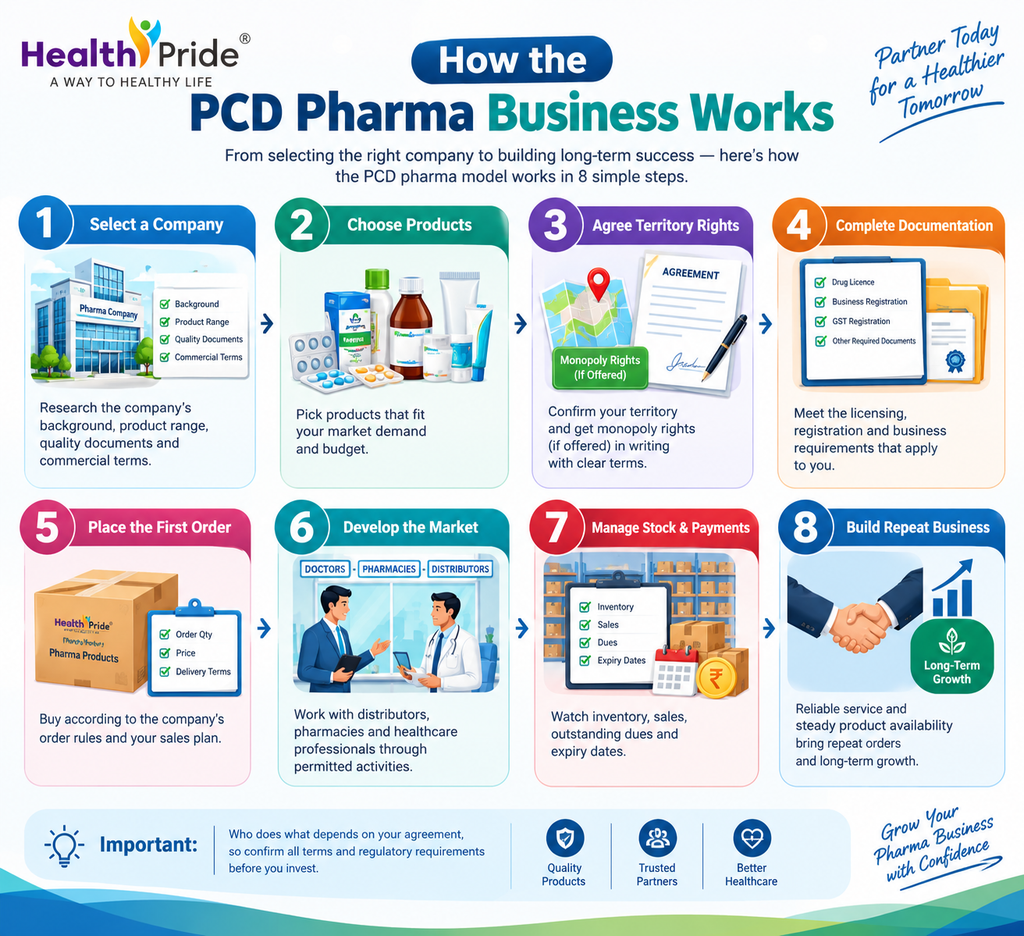
Takeaway: A PCD partner picks a company, agrees territory and products, completes licensing, places an initial order and then develops the market and manages stock.
- Select a company. Research its background, product range, quality documents and commercial terms.
- Choose products. Pick items that fit your market and budget.
- Agree territory rights. If monopoly rights are offered, get the conditions in writing.
- Complete documentation. Meet the licensing, registration and business requirements that apply to you.
- Place the first order. Buy according to the company’s order rules and your sales plan.
- Develop the market. Work with distributors, pharmacies and healthcare professionals through permitted activities.
- Manage stock and payments. Watch inventory, sales, dues and expiry dates.
- Build repeat business. Reliable service and steady availability bring orders back.
Who does what depends on your agreement, so confirm terms and regulatory requirements before you invest.
Types of PCD pharma business models
Takeaway: The main models are monopoly PCD, non-monopoly PCD, distributorship, third-party manufacturing and own manufacturing; they differ mainly in capital, competition and regulatory load.
| Model | How it works | Watch out for |
|---|---|---|
| Monopoly PCD | The company grants defined territory rights under a written agreement and may agree not to appoint another partner for the same products there. | Territory, products covered, duration, renewal and purchase commitments. |
| Non-monopoly PCD | The company can appoint several partners in one area. | More direct competition, so compare pricing and demand first. |
| Distributorship | You buy and supply medicines to eligible retailers, pharmacies or hospitals, depending on your licences. | Inventory, logistics, collections and working capital. |
| Third-party manufacturing | A manufacturer produces medicines under your brand or labelling arrangement. | Manufacturing, approval, labelling and licensing requirements. |
| Own manufacturing | You run your own plant. | The highest infrastructure, quality and regulatory demands. |
Which one should you choose? If you have limited capital and want to learn the market, monopoly PCD is the usual starting point. The others make sense once you have capital, experience or a brand plan. Compare capital, responsibilities, regulation and risk before you decide.
How to start a PCD pharma business in India
Takeaway: Start with local market research, then pick a company, finalise products, sort licences, lock the agreement in writing and plan your cash before the first order.
Step 1: Research your market
Look at local demand, competitors, product availability and pricing in your territory. Choose product categories that fit your market, not ones that merely advertise a big margin.
Step 2: Choose the company
Compare several. Look at background, range, quality documents, pricing, supply reliability and support. Then ask the plain question: can this company keep the products I need in stock, on terms my capital can handle? Browsing a company’s catalogue and product categories is a quick first filter.
Step 3: Select products
Ranges vary by company, but commonly include tablets and capsules, syrups and oral liquids, dry syrups and suspensions, injectables, ointments, creams and gels, eye and ear drops, paediatric and dermatology products, nutraceuticals and Ayurvedic products. For example, Health Pride lists tablets, capsules, syrups, injections, ointments and Ayurvedic products. Verify approvals, manufacturing information and demand before you order.
Step 4: Licensing and documents
What you need depends on your activities, products and state and central rules. It may include a drug sale or distribution licence, business registration, GST registration where applicable, qualified personnel where required, invoices, product records and a written agreement.
A franchise agreement doesn’t replace the licences your business needs. Confirm requirements with your State Drugs Control Department or a qualified regulatory professional before you start.
Step 5: Territory and agreement
If you want monopoly rights, get them documented clearly. Check the agreement for:
- Area and products covered
- Exclusivity conditions and exceptions
- Minimum order requirements
- Pricing and payment terms
- Duration and renewal
- Dispatch and availability conditions
- Returns, expiry and complaint handling
- Termination terms and responsibilities
Written terms prevent most later arguments.
Step 6: Plan your investment
Add up opening stock, transport, storage, marketing and running costs, then keep enough working capital for repeat orders and late payments. Don’t buy more stock than you can realistically sell.
Step 7: Develop your market
Build professional relationships, use accurate and legally permitted promotion, and give correct product information.
Step 8: Track performance
Watch sales, product margins, expenses, stock movement, collections and expiry risk, and adjust purchases to actual demand.
How much investment does PCD pharma need?
Takeaway: No single amount applies to every PCD business; the budget depends on the company, product range, minimum order quantity, territory and scale.
| Expense | What to consider |
|---|---|
| Initial stock | Purchase value and minimum order requirement |
| Business setup | Registration and setup costs |
| Licensing and compliance | Licences, documentation and professional advice |
| Transportation | Freight, handling and delivery |
| Marketing | Permitted promotional material and outreach |
| Storage | Suitable conditions and stock management |
| Working capital | Routine expenses, payment delays and repeat orders |
Ask for a written quotation, and confirm whether taxes, freight, promotional material and other charges are included. A PTR/PTS calculator helps you work out trade prices and margins before you commit.
Is PCD pharma profitable?
Takeaway: PCD pharma can be profitable, but results depend on pricing, sales volume, costs, competition, collections and stock control, and a loss is possible.
Know two terms. Gross profit is sales revenue minus the cost of goods sold. Operating profit is what remains after operating costs such as transport, salaries, rent, marketing and administration; taxes and financing costs reduce it further.
Example: a monthly profit calculation
This is a hypothetical example to show the arithmetic.
| Particulars | Amount |
|---|---|
| Monthly sales revenue | ₹3,00,000 |
| Cost of products sold | ₹2,10,000 |
| Gross profit | ₹90,000 |
| Transport and delivery | ₹10,000 |
| Marketing expenses | ₹15,000 |
| Staff and other operating expenses | ₹15,000 |
| Illustrative operating profit | ₹50,000 |
These figures are not an industry average or a promise of income. Real results can be lower, or the business can lose money.
What moves your profit
- Product margins: Purchase cost, selling price and discounts differ by product.
- Sales volume: More sales help only if the margin is real and the money is collected.
- Operating expenses: Transport, salaries, rent and marketing come out of your gross profit.
- Payment collection: Late payments can wreck cash flow even when sales look good on paper.
- Expiry and unsold stock: Items that expire unsold are a loss, depending on the company’s return policy.
- Competition: Local rivals affect pricing, retention and achievable sales.
Before you commit, build a product-wise estimate using actual purchase prices, expected selling prices, realistic sales and every expense.
Advantages of a PCD pharma business
Takeaway: The main benefits are lower setup cost, a ready product range, a defined territory and room to grow, but none of them is guaranteed.
- No plant to build. You work with an existing company, so infrastructure needs are far lower than in manufacturing.
- Ready portfolio. The company may already have medicines, product information, packaging and supply in place, so you can start selling without creating products.
- A local territory to build. An agreed area lets you focus on local demand and customer relationships.
- Repeat orders. Reliable supply, suitable products and good service bring customers back.
- Several product categories. Depending on the company, you can serve different segments.
- Room to expand. You can add products or territories when the agreement, demand, capital and compliance allow.
These are potential benefits, not guaranteed outcomes. Success depends on the model, the company’s support and how well you execute.
Disadvantages and risks
Takeaway: The biggest risks are supplier dependence, working capital strain, unsold or expired stock and unclear territory terms.
- Supplier dependence. Availability, dispatch time and quality depend on the company, and delays hurt your customers.
- Competition. Other brands and distributors may already serve your area, and a customer base takes time.
- Working capital pressure. Stock, transport and delayed payments strain cash flow.
- Unsold and expired products. Slow stock causes losses, so understand the written return and expiry policy first.
- Limited monopoly rights. They are only as strong as the written agreement. Check territory, products, exclusivity and purchase commitments.
- Regulatory duties. Licensing, storage, distribution, record-keeping and promotion rules all apply.
- No guaranteed profit. A reputable company can’t promise a fixed level of sales or income to every partner.
Scope of PCD pharma in India
Takeaway: Opportunity exists at district level and in both general and specialty segments, but the real scope in your area depends on local demand, competition and compliance, not on assumed industry growth.
- Local and district markets. Research your area to find unmet needs, then build relationships with distributors, pharmacies and healthcare professionals.
- General and specialty segments. Depending on demand and the company’s range: general medicine, dermatology, paediatric, nutritional supplements and more.
- Digital marketing. A professional website, useful educational content and responsible outreach can bring in enquiries. Follow the pharmaceutical advertising and promotion rules that apply.
- Distribution growth. Better fulfilment, stock availability, service and coverage help, provided you have the working capital and compliance to back them.
- Long-term development. A reliable supplier, accurate information and careful finances build a lasting business.
Test the opportunity with local market research rather than assumptions about guaranteed growth.
How to choose the best PCD pharma company
Takeaway: Choose on verified documents, supply reliability and clear written terms, not on the biggest advertised margin.
Check these before you sign:
- Company background: Verify identity, reputation and business history.
- Quality documentation: Check manufacturing licences, quality records and the validity and scope of certifications.
- Product portfolio: Make sure the range matches your market.
- Pricing and margins: Review purchase prices, discounts, taxes, freight and other charges. The PTR/PTS calculator is handy for this.
- Minimum order quantity: Confirm the first order fits your budget.
- Territory rights: Get every monopoly or territory term in writing.
- Supply reliability: Ask about stock, dispatch times and fulfilment.
- Return policy: Clarify complaints, damaged goods and eligible returns.
- Marketing support: Confirm what material and product information you’ll get. See Health Pride’s marketing facility page as an example of what a company can list.
- Partner feedback: Where you can, check independently with current partners.
Don’t pick a company only because it advertises high margins or profits. Documents you can verify, dependable supply and realistic planning matter just as much.
Why consider Health Pride for PCD pharma?
Takeaway: Health Pride is a Panchkula, Haryana based company that offers PCD pharma franchises; check its current products, territory availability and terms directly before deciding.
Health Pride is a pharmaceutical company in Panchkula, Haryana. According to its official website, it offers products across several categories and monopoly-based franchise arrangements. Its site also publishes a quality policy, about page, product gallery and FAQs, and you can read more on its blog.
When evaluating Health Pride, or any other company, look at:
- Available product categories
- Manufacturing and quality documentation
- Territory availability and written franchise terms
- Pricing and minimum order requirements
- Supply and dispatch arrangements
- Promotional support and partner communication
To ask about current franchise information, use the contact page. Choose a partner on verified information and a written agreement that meets your needs.
Documents and questions to check before starting
Takeaway: Before your first order, get written answers on products, territory, minimum order, prices, licences, quality documents, dispatch, returns, marketing support and agreement terms.
Ask the company:
- Which products are available in my territory?
- Are monopoly rights available for my preferred area?
- What is the minimum initial order?
- What are the purchase prices and payment terms?
- Which licences and registrations must I obtain?
- What product and quality documents can I verify?
- What are the dispatch timelines?
- How are complaints and eligible returns handled?
- What marketing support is included?
- What are the agreement’s duration, renewal and termination conditions?
Keep copies of the agreement, invoices, licences and other required records, and take professional advice if any regulatory or commercial term is unclear.
Key takeaways
- PCD pharma lets you promote and distribute a company’s medicines in an agreed territory without a factory.
- Monopoly rights are only as strong as the written agreement.
- Budget for stock, compliance and working capital, not just the first order.
- Profit is never guaranteed; build a product-wise estimate first.
- Verify licences and certificates yourself before paying.
FAQs about PCD pharma
1. What is PCD pharma?
A business arrangement where a pharmaceutical company authorises a partner to promote and distribute its products under agreed terms. PCD stands for Propaganda Cum Distribution.
2. How does the PCD pharma business work?
The company supplies products and may provide agreed promotional support. The partner develops the market, manages orders and builds customer relationships, with exact duties set by the agreement.
3. Is PCD pharma profitable?
It can be, but earnings depend on sales volume, margins, expenses, competition, collections and stock control. Profit is not guaranteed.
4. How much investment does PCD pharma need?
It depends on the company, product range, minimum order quantity and scale. Get a written quotation and count both opening costs and ongoing working capital.
5. Is a drug licence required?
Requirements depend on your activities and products. Confirm them with your State Drugs Control Department before you begin operations.
6. What is monopoly-based PCD pharma?
An arrangement where a company grants specified territory rights to a partner under a written agreement. How exclusive it is depends on the agreed terms.
7. Can beginners start a PCD pharma business?
Yes, they can explore it, but should first understand demand, investment, product needs, licensing duties and risks.
8. What products do PCD companies offer?
Depending on the company: tablets, capsules, syrups, dry syrups, injectables, ointments, creams, eye and ear drops, nutritional supplements and Ayurvedic products.
9. What is the difference between PCD pharma and third-party manufacturing?
PCD means promoting and distributing a company’s products. Third-party manufacturing means contracting a manufacturer to produce products under an agreed brand or arrangement, subject to regulatory requirements.
10. How do I choose the best PCD pharma company in India?
Compare credentials, quality documents, range, pricing, minimum order quantity, supply reliability, territory rights and written terms.
11. Can I start in a small town?
Potentially. It depends on local demand, competition, logistics, suitable products, working capital and compliance.
12. What are the main risks?
Weak demand, competition, delayed payments, supplier problems, unsold or expired stock, unclear territory agreements and regulatory non-compliance.
Conclusion
PCD pharma can work for you if you want to enter pharma marketing and distribution without building a plant, but only with market research, the right products, a dependable supplier, enough working capital and compliance. Compare companies, verify their documents, pin down territory rights in writing and run your own profit numbers before investing. If you’re exploring franchise options, you can review Health Pride‘s current product range and ask about franchise terms through its contact page.
Research your market, verify your partner and plan carefully.
Author box
Health Pride is a pharmaceutical company based in Panchkula, Haryana, offering PCD pharma franchise opportunities. Visit healthpride.in to review its products and ask about franchise availability.
