Written by the Health Pride franchise desk · Last updated 08 October 2026
Quick answer: PCD pharma franchise terms and conditions are the written rules between a manufacturer and its marketing partner. They cover six things: territory and monopoly rights, minimum order quantity, licences, pricing and payment, product range, and the agreement period with exit terms. Get the dispatch window, payment mode and monopoly rights in writing before signing.
A PCD pharma franchise agreement comes down to six things: your territory, the minimum order, your licences, how pricing and payment work, the product range, and how you exit. If you’re signing in 2026, make sure three of them are on paper before anything else: the dispatch window, the payment mode, and your monopoly rights. A verbal promise is worth nothing the day a dispute starts.
From the outside, starting a PCD franchise looks easy. Pick a company, pick a territory, start selling. The fine print is where it gets decided. Minimum order size, dispatch timelines and payment rules hit your cash flow from month one.
This guide walks through each term in plain language so you can read the agreement yourself and ask the right questions first.
What are PCD pharma franchise terms and conditions?
Takeaway: PCD pharma franchise terms and conditions are the written rules that say what you must buy, what you can sell, where you can sell it and how you pay.
PCD stands for Propaganda cum Distribution. Under this model, a manufacturer gives you the right to promote and sell its products in a fixed area, and you earn the margin on each sale. The agreement is the only thing that defines that arrangement, so reading it properly is part of the franchise process, not a formality that comes after it.
The six clauses every agreement covers
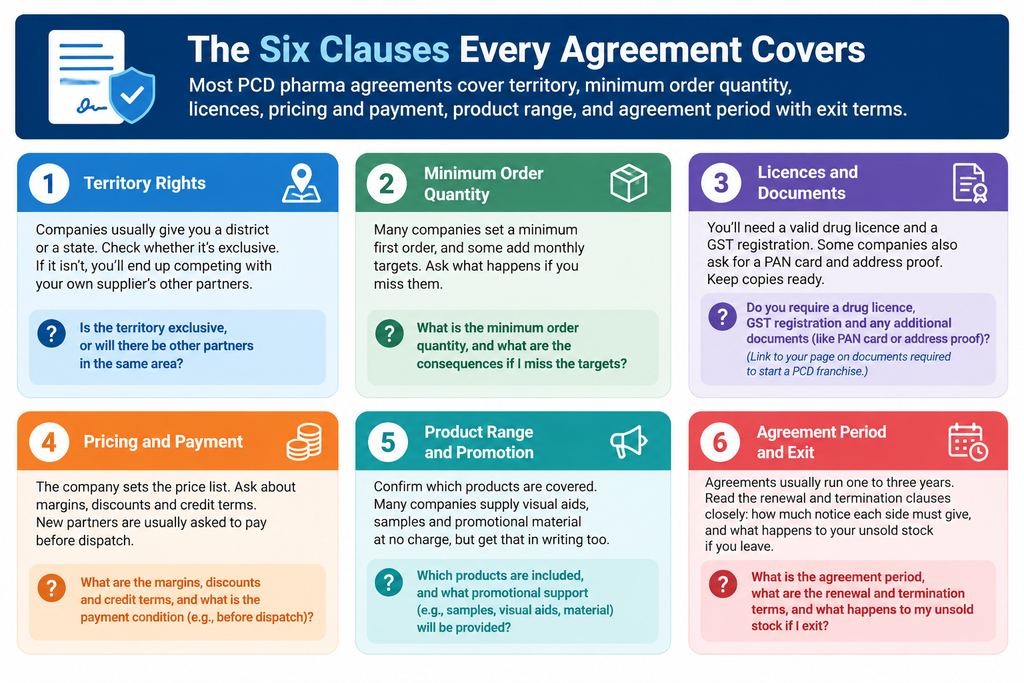
Takeaway: Most PCD pharma agreements cover territory, minimum order quantity, licences, pricing and payment, product range, and agreement period with exit terms.
Territory rights. Companies usually give you a district or a state. Check whether it’s exclusive. If it isn’t, you’ll end up competing with your own supplier’s other partners.
Minimum order quantity. Many companies set a minimum first order, and some add monthly targets. Ask what happens if you miss them.
Licences and documents. You’ll need a valid drug licence and a GST registration. Some companies also ask for a PAN card and address proof. Keep copies ready. (Link this line to your existing page on documents required to start a PCD franchise.)
Pricing and payment. The company sets the price list. Ask about margins, discounts and credit terms. New partners are usually asked to pay before dispatch.
Product range and promotion. Confirm which products are covered. Many companies supply visual aids, samples and promotional material at no charge, but get that in writing too.
Agreement period and exit. Agreements usually run one to three years. Read the renewal and termination clauses closely: how much notice each side must give, and what happens to your unsold stock if you leave.
Minimum order quantity (MOQ)
Takeaway: The minimum order quantity (MOQ) in a PCD franchise is the smallest order a company will accept at one time, and it decides how much cash you lock into stock.
MOQ can be set by invoice value, number of packs or number of products. Too high, and a new partner can end up sitting on slow-moving medicines. Too low, and the company may not offer good rates or dispatch priority. You’re looking for a fair balance, not just the smallest number.
Three questions are worth asking:
- Is the MOQ the same for the first order and for repeat orders?
- Can you mix products to reach it?
- Will the company accept a lower figure while you build your territory?
A company that offers a flexible MOQ to new partners usually wants a long relationship. That’s a good sign.
Also check how the MOQ connects to your exclusivity. Some companies tie area rights to a yearly sales target. This is called a monopoly-based PCD franchise. Miss the target and the rights can be withdrawn, so know the number before you accept.
Warehousing and dispatch
Takeaway: A PCD franchise agreement should state a dispatch window as a specific number of working days after payment is received, not as “soon.”
After your order is confirmed, the company’s warehouse picks, packs and labels the goods. You receive an LR number or tracking ID to follow the consignment.
When the boxes arrive, check them before you sign the receipt. Look at quantity, batch numbers and the condition of the packs. Report any damage or shortage inside the time limit the agreement gives you; after that, you may have no claim. And ask about near-expiry and damaged stock now, not later, because that policy is what protects your money.
Payment terms
Takeaway: PCD pharma franchise payment terms decide your cash flow, and most new partners are asked to pay in advance, in full or in part.
| Payment model | How it works | Worth knowing |
|---|---|---|
| Full advance | You pay the whole purchase order before manufacturing or dispatch. | Some companies give better rates or priority handling for this. Ask rather than assume. |
| Part advance + COD | You pay part at order, the rest on delivery. | Common middle ground for newer partners. |
| Credit line | A short credit period, for example 15 to 30 days, for established partners. | Often backed by post-dated cheques or a bank guarantee. |
Bank transfer, UPI and cheque are the usual modes. Pay only into the company’s official account, keep the proof, and make sure every payment has a matching GST invoice.
Then look for hidden costs. Packing, freight and insurance may or may not be in the quoted price, and a low rate that picks up freight at the end isn’t really low. Ask what happens if you pay late, too, because some companies hold your next dispatch until dues are cleared.
Finally, read the return and credit note rules. If a batch is defective or close to expiry, the agreement should say who takes the loss and how fast the company issues a credit note.
[Visual / Diagram Suggestion: Timeline showing order, payment, dispatch window, delivery check and credit-note deadline.]
Checklist before you sign
Takeaway: Before signing a PCD pharma franchise agreement, confirm seven points in writing, from territory rights to field support.
- Are territory and monopoly rights written clearly in the agreement?
- Is there a fixed dispatch window, in working days?
- Are the payment mode, advance amount and credit period spelled out?
- Are freight, packing and insurance charges stated?
- Is there a clear policy for near-expiry, damaged and wrong stock?
- Are the products WHO-GMP certified, and can you see the licence details?
- Will you get marketing material, samples and field support?
Signs of a bad PCD pharma franchise agreement
Takeaway: One red flag in a PCD franchise agreement is reason to push back; two or more is reason to walk away.
Not every company offering you a franchise deserves your money. Some put everything in writing. Others hope you won’t ask. Scan the agreement for these:
- Monopoly rights that stay verbal. If a company says your territory is exclusive but won’t write it down, it’s a sales pitch, not a clause. “We usually don’t give the same area to two partners” means what it says: usually.
- A dispatch window with no number. “Soon” protects nobody. A company running a tight supply chain will name the working days.
- Freight and packing missing from the price list. If they surface only after you order, the quote was never your real cost.
- No written policy on near-expiry or damaged stock. If the agreement is silent, you’ll likely absorb the loss.
- Pressure to sign today. A partner with nothing to hide expects you to read everything and compare it with another company’s terms.
- A WHO-GMP certificate or drug licence you’re never shown. Ask to see it. An excuse instead of a document is your answer.
- No dispute resolution clause. Without one, even a small disagreement could end up in a court far from your city, and most partners give up and swallow the loss rather than pay for that.
A company confident in its terms will write every one of these down without being asked twice.
Key takeaways
- Six clauses define the agreement: territory, MOQ, licences, pricing and payment, product range, exit.
- Get dispatch window, payment mode and monopoly rights in writing. Verbal promises don’t hold up in a dispute.
- MOQ controls how much you invest in stock; ask whether it’s flexible while you build your territory.
- Hidden freight, packing and insurance charges change your true cost.
- Compare at least two companies before choosing.
FAQs
What does PCD stand for in pharma?
PCD stands for Propaganda cum Distribution. The company supplies the medicines, and you promote and sell them in your allotted area.
What are the main terms in a PCD franchise agreement?
Territory, contract period, product list, pricing, minimum order, payment, dispatch, returns and company support.
What is the minimum order quantity in a PCD franchise?
MOQ is the smallest order a PCD company will accept at one time, counted by value, packs or products. Check whether repeat orders carry the same figure.
Which documents are needed to start a PCD franchise?
Usually a drug licence, GST registration, PAN card, address proof and identity proof.
Can monopoly rights be withdrawn?
Yes, if the agreement links them to sales targets and you don’t meet them. Read that clause carefully.
How long does delivery take?
It depends on distance and transport mode. Ask for the dispatch window in writing.
Which payment modes are accepted?
Bank transfer, UPI and cheque are the usual ones. Always pay into the company’s official account.
Is advance payment compulsory?
It’s common, but some companies accept part payment or give regular partners a short credit period.
Are freight charges included in the price?
It varies. Ask whether packing, freight and insurance are included so you can work out your true cost.
What happens to near-expiry stock?
The agreement should state the return policy and its time limit. Check it before placing a large order.
What should I do next if a company won’t put its terms in writing?
Treat that as your answer and move on to another company. Terms that only exist verbally can’t be enforced later.
About Healthpride
Healthpride is a WHO-GMP and ISO 9001 certified PCD pharma company based in Panchkula, Haryana, with 20+ years in the industry, 180+ DCGI-approved formulations and 1,500+ franchise partners across 34 locations. The company drafts and reviews its own franchise agreements along the lines described in this guide.
Thinking about a PCD franchise in 2026? Ask Healthpride for its agreement and read these terms in writing before you sign. [Check territory availability →]