Monthly Archives: October 2026

PCD Pharma Franchise in India Complete Guide to Business Models, Investment, Profit and How to Start

PCD Pharma: Complete Guide to Business Models, Investment, Profit and Growth in India

Quick answer: PCD (Propaganda Cum Distribution) pharma is a business model where a pharmaceutical company authorises a partner to promote and distribute its medicines in an agreed territory. The partner needs no factory, but does need working capital, the right licences and a written agreement covering territory, pricing and returns.

If you’re a medical representative, distributor, pharmacist or first-time entrepreneur, PCD pharma is probably the lowest-cost way into the pharma business. It is also easy to get wrong. This guide covers the business models, investment, a worked profit example, licensing, risks and how to pick a partner company, with the checks to run before you pay anyone.

What is PCD pharma?

Takeaway: PCD pharma means a pharmaceutical company appoints a partner to promote and distribute its products under agreed terms, so the partner can sell medicines without owning a manufacturing plant.

PCD stands for Propaganda Cum Distribution. The company usually supplies the medicines, product information, promotional material and dispatch. The partner builds the territory: relationships, orders, stock and service, all through legally permitted channels.

Take a simple case. A company appoints you for one district. You sell its products there, under the territory rights, pricing and rules written in your agreement.

How the PCD pharma business works

Takeaway: A PCD partner picks a company, agrees territory and products, completes licensing, places an initial order and then develops the market and manages stock.

  1. Select a company. Research its background, product range, quality documents and commercial terms.
  2. Choose products. Pick items that fit your market and budget.
  3. Agree territory rights. If monopoly rights are offered, get the conditions in writing.
  4. Complete documentation. Meet the licensing, registration and business requirements that apply to you.
  5. Place the first order. Buy according to the company’s order rules and your sales plan.
  6. Develop the market. Work with distributors, pharmacies and healthcare professionals through permitted activities.
  7. Manage stock and payments. Watch inventory, sales, dues and expiry dates.
  8. Build repeat business. Reliable service and steady availability bring orders back.

Who does what depends on your agreement, so confirm terms and regulatory requirements before you invest.
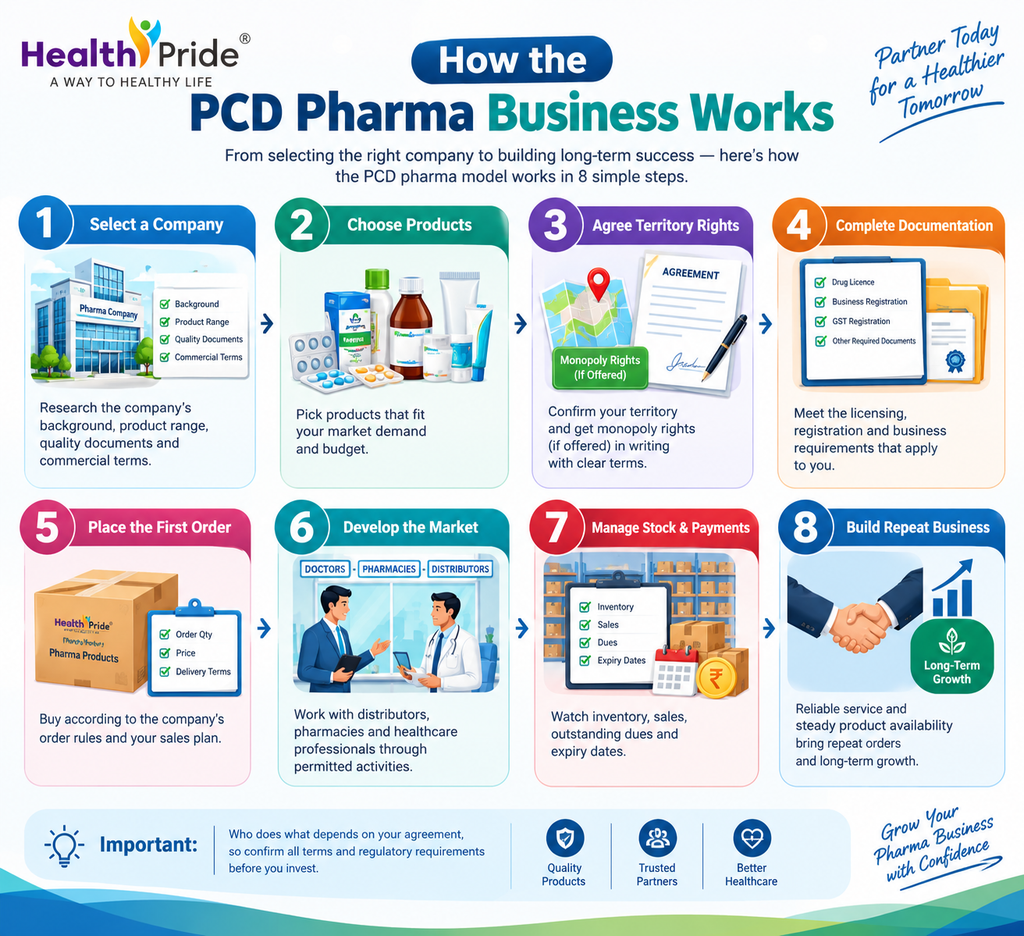
PCD pharma business works

Types of PCD pharma business models

Takeaway: The main models are monopoly PCD, non-monopoly PCD, distributorship, third-party manufacturing and own manufacturing; they differ mainly in capital, competition and regulatory load.

ModelHow it worksWatch out for
Monopoly PCDThe company grants defined territory rights under a written agreement and may agree not to appoint another partner for the same products there.Territory, products covered, duration, renewal and purchase commitments.
Non-monopoly PCDThe company can appoint several partners in one area.More direct competition, so compare pricing and demand first.
DistributorshipYou buy and supply medicines to eligible retailers, pharmacies or hospitals, depending on your licences.Inventory, logistics, collections and working capital.
Third-party manufacturingA manufacturer produces medicines under your brand or labelling arrangement.Manufacturing, approval, labelling and licensing requirements.
Own manufacturingYou run your own plant.The highest infrastructure, quality and regulatory demands.

Which one should you choose? If you have limited capital and want to learn the market, monopoly PCD is the usual starting point. The others make sense once you have capital, experience or a brand plan. Compare capital, responsibilities, regulation and risk before you decide.

How to start a PCD pharma business in India

Takeaway: Start with local market research, then pick a company, finalise products, sort licences, lock the agreement in writing and plan your cash before the first order.

Step 1: Research your market

Look at local demand, competitors, product availability and pricing in your territory. Choose product categories that fit your market, not ones that merely advertise a big margin.

Step 2: Choose the company

Compare several. Look at background, range, quality documents, pricing, supply reliability and support. Then ask the plain question: can this company keep the products I need in stock, on terms my capital can handle? Browsing a company’s catalogue and product categories is a quick first filter.

Step 3: Select products

Ranges vary by company, but commonly include tablets and capsules, syrups and oral liquids, dry syrups and suspensions, injectables, ointments, creams and gels, eye and ear drops, paediatric and dermatology products, nutraceuticals and Ayurvedic products. For example, Health Pride lists tablets, capsules, syrups, injections, ointments and Ayurvedic products. Verify approvals, manufacturing information and demand before you order.

Step 4: Licensing and documents

What you need depends on your activities, products and state and central rules. It may include a drug sale or distribution licence, business registration, GST registration where applicable, qualified personnel where required, invoices, product records and a written agreement.

A franchise agreement doesn’t replace the licences your business needs. Confirm requirements with your State Drugs Control Department or a qualified regulatory professional before you start.

Step 5: Territory and agreement

If you want monopoly rights, get them documented clearly. Check the agreement for:

  • Area and products covered
  • Exclusivity conditions and exceptions
  • Minimum order requirements
  • Pricing and payment terms
  • Duration and renewal
  • Dispatch and availability conditions
  • Returns, expiry and complaint handling
  • Termination terms and responsibilities

Written terms prevent most later arguments.

Step 6: Plan your investment

Add up opening stock, transport, storage, marketing and running costs, then keep enough working capital for repeat orders and late payments. Don’t buy more stock than you can realistically sell.

Step 7: Develop your market

Build professional relationships, use accurate and legally permitted promotion, and give correct product information.

Step 8: Track performance

Watch sales, product margins, expenses, stock movement, collections and expiry risk, and adjust purchases to actual demand.

How much investment does PCD pharma need?

Takeaway: No single amount applies to every PCD business; the budget depends on the company, product range, minimum order quantity, territory and scale.

ExpenseWhat to consider
Initial stockPurchase value and minimum order requirement
Business setupRegistration and setup costs
Licensing and complianceLicences, documentation and professional advice
TransportationFreight, handling and delivery
MarketingPermitted promotional material and outreach
StorageSuitable conditions and stock management
Working capitalRoutine expenses, payment delays and repeat orders

Ask for a written quotation, and confirm whether taxes, freight, promotional material and other charges are included. A PTR/PTS calculator helps you work out trade prices and margins before you commit.

Is PCD pharma profitable?

Takeaway: PCD pharma can be profitable, but results depend on pricing, sales volume, costs, competition, collections and stock control, and a loss is possible.

Know two terms. Gross profit is sales revenue minus the cost of goods sold. Operating profit is what remains after operating costs such as transport, salaries, rent, marketing and administration; taxes and financing costs reduce it further.

Example: a monthly profit calculation

This is a hypothetical example to show the arithmetic.

ParticularsAmount
Monthly sales revenue₹3,00,000
Cost of products sold₹2,10,000
Gross profit₹90,000
Transport and delivery₹10,000
Marketing expenses₹15,000
Staff and other operating expenses₹15,000
Illustrative operating profit₹50,000

These figures are not an industry average or a promise of income. Real results can be lower, or the business can lose money.

What moves your profit

  • Product margins: Purchase cost, selling price and discounts differ by product.
  • Sales volume: More sales help only if the margin is real and the money is collected.
  • Operating expenses: Transport, salaries, rent and marketing come out of your gross profit.
  • Payment collection: Late payments can wreck cash flow even when sales look good on paper.
  • Expiry and unsold stock: Items that expire unsold are a loss, depending on the company’s return policy.
  • Competition: Local rivals affect pricing, retention and achievable sales.

Before you commit, build a product-wise estimate using actual purchase prices, expected selling prices, realistic sales and every expense.

Advantages of a PCD pharma business

Takeaway: The main benefits are lower setup cost, a ready product range, a defined territory and room to grow, but none of them is guaranteed.

  • No plant to build. You work with an existing company, so infrastructure needs are far lower than in manufacturing.
  • Ready portfolio. The company may already have medicines, product information, packaging and supply in place, so you can start selling without creating products.
  • A local territory to build. An agreed area lets you focus on local demand and customer relationships.
  • Repeat orders. Reliable supply, suitable products and good service bring customers back.
  • Several product categories. Depending on the company, you can serve different segments.
  • Room to expand. You can add products or territories when the agreement, demand, capital and compliance allow.

These are potential benefits, not guaranteed outcomes. Success depends on the model, the company’s support and how well you execute.

Disadvantages and risks

Takeaway: The biggest risks are supplier dependence, working capital strain, unsold or expired stock and unclear territory terms.

  • Supplier dependence. Availability, dispatch time and quality depend on the company, and delays hurt your customers.
  • Competition. Other brands and distributors may already serve your area, and a customer base takes time.
  • Working capital pressure. Stock, transport and delayed payments strain cash flow.
  • Unsold and expired products. Slow stock causes losses, so understand the written return and expiry policy first.
  • Limited monopoly rights. They are only as strong as the written agreement. Check territory, products, exclusivity and purchase commitments.
  • Regulatory duties. Licensing, storage, distribution, record-keeping and promotion rules all apply.
  • No guaranteed profit. A reputable company can’t promise a fixed level of sales or income to every partner.

Scope of PCD pharma in India

Takeaway: Opportunity exists at district level and in both general and specialty segments, but the real scope in your area depends on local demand, competition and compliance, not on assumed industry growth.

  • Local and district markets. Research your area to find unmet needs, then build relationships with distributors, pharmacies and healthcare professionals.
  • General and specialty segments. Depending on demand and the company’s range: general medicine, dermatology, paediatric, nutritional supplements and more.
  • Digital marketing. A professional website, useful educational content and responsible outreach can bring in enquiries. Follow the pharmaceutical advertising and promotion rules that apply.
  • Distribution growth. Better fulfilment, stock availability, service and coverage help, provided you have the working capital and compliance to back them.
  • Long-term development. A reliable supplier, accurate information and careful finances build a lasting business.

Test the opportunity with local market research rather than assumptions about guaranteed growth.

How to choose the best PCD pharma company

Takeaway: Choose on verified documents, supply reliability and clear written terms, not on the biggest advertised margin.

Check these before you sign:

  1. Company background: Verify identity, reputation and business history.
  2. Quality documentation: Check manufacturing licences, quality records and the validity and scope of certifications.
  3. Product portfolio: Make sure the range matches your market.
  4. Pricing and margins: Review purchase prices, discounts, taxes, freight and other charges. The PTR/PTS calculator is handy for this.
  5. Minimum order quantity: Confirm the first order fits your budget.
  6. Territory rights: Get every monopoly or territory term in writing.
  7. Supply reliability: Ask about stock, dispatch times and fulfilment.
  8. Return policy: Clarify complaints, damaged goods and eligible returns.
  9. Marketing support: Confirm what material and product information you’ll get. See Health Pride’s marketing facility page as an example of what a company can list.
  10. Partner feedback: Where you can, check independently with current partners.

Don’t pick a company only because it advertises high margins or profits. Documents you can verify, dependable supply and realistic planning matter just as much.

Why consider Health Pride for PCD pharma?

Takeaway: Health Pride is a Panchkula, Haryana based company that offers PCD pharma franchises; check its current products, territory availability and terms directly before deciding.

Health Pride is a pharmaceutical company in Panchkula, Haryana. According to its official website, it offers products across several categories and monopoly-based franchise arrangements. Its site also publishes a quality policy, about page, product gallery and FAQs, and you can read more on its blog.

When evaluating Health Pride, or any other company, look at:

  • Available product categories
  • Manufacturing and quality documentation
  • Territory availability and written franchise terms
  • Pricing and minimum order requirements
  • Supply and dispatch arrangements
  • Promotional support and partner communication

To ask about current franchise information, use the contact page. Choose a partner on verified information and a written agreement that meets your needs.

Documents and questions to check before starting

Takeaway: Before your first order, get written answers on products, territory, minimum order, prices, licences, quality documents, dispatch, returns, marketing support and agreement terms.

Ask the company:

  • Which products are available in my territory?
  • Are monopoly rights available for my preferred area?
  • What is the minimum initial order?
  • What are the purchase prices and payment terms?
  • Which licences and registrations must I obtain?
  • What product and quality documents can I verify?
  • What are the dispatch timelines?
  • How are complaints and eligible returns handled?
  • What marketing support is included?
  • What are the agreement’s duration, renewal and termination conditions?

Keep copies of the agreement, invoices, licences and other required records, and take professional advice if any regulatory or commercial term is unclear.

Key takeaways

  • PCD pharma lets you promote and distribute a company’s medicines in an agreed territory without a factory.
  • Monopoly rights are only as strong as the written agreement.
  • Budget for stock, compliance and working capital, not just the first order.
  • Profit is never guaranteed; build a product-wise estimate first.
  • Verify licences and certificates yourself before paying.

FAQs about PCD pharma

1. What is PCD pharma?

A business arrangement where a pharmaceutical company authorises a partner to promote and distribute its products under agreed terms. PCD stands for Propaganda Cum Distribution.

2. How does the PCD pharma business work?

The company supplies products and may provide agreed promotional support. The partner develops the market, manages orders and builds customer relationships, with exact duties set by the agreement.

3. Is PCD pharma profitable?

It can be, but earnings depend on sales volume, margins, expenses, competition, collections and stock control. Profit is not guaranteed.

4. How much investment does PCD pharma need?

It depends on the company, product range, minimum order quantity and scale. Get a written quotation and count both opening costs and ongoing working capital.

5. Is a drug licence required?

Requirements depend on your activities and products. Confirm them with your State Drugs Control Department before you begin operations.

6. What is monopoly-based PCD pharma?

An arrangement where a company grants specified territory rights to a partner under a written agreement. How exclusive it is depends on the agreed terms.

7. Can beginners start a PCD pharma business?

Yes, they can explore it, but should first understand demand, investment, product needs, licensing duties and risks.

8. What products do PCD companies offer?

Depending on the company: tablets, capsules, syrups, dry syrups, injectables, ointments, creams, eye and ear drops, nutritional supplements and Ayurvedic products.

9. What is the difference between PCD pharma and third-party manufacturing?

PCD means promoting and distributing a company’s products. Third-party manufacturing means contracting a manufacturer to produce products under an agreed brand or arrangement, subject to regulatory requirements.

10. How do I choose the best PCD pharma company in India?

Compare credentials, quality documents, range, pricing, minimum order quantity, supply reliability, territory rights and written terms.

11. Can I start in a small town?

Potentially. It depends on local demand, competition, logistics, suitable products, working capital and compliance.

12. What are the main risks?

Weak demand, competition, delayed payments, supplier problems, unsold or expired stock, unclear territory agreements and regulatory non-compliance.

Conclusion

PCD pharma can work for you if you want to enter pharma marketing and distribution without building a plant, but only with market research, the right products, a dependable supplier, enough working capital and compliance. Compare companies, verify their documents, pin down territory rights in writing and run your own profit numbers before investing. If you’re exploring franchise options, you can review Health Pride‘s current product range and ask about franchise terms through its contact page.

Research your market, verify your partner and plan carefully.

Author box

Health Pride is a pharmaceutical company based in Panchkula, Haryana, offering PCD pharma franchise opportunities. Visit healthpride.in to review its products and ask about franchise availability.
Top 15 PCD Pharma Companies in India

Top 15 PCD Pharma Companies in India

Quick answer: A PCD (Propaganda-Cum-Distribution) pharma franchise lets you promote and sell a company’s medicines in an assigned territory, usually with monopoly rights. Pick a partner by checking licences and GMP documents, product range, territory terms, minimum order quantity and promotional support, not by brand name alone.

India’s pharma sector has room for distributors, medical representatives and first-time entrepreneurs, and the PCD model is the cheapest way in. You don’t build a plant. You take an existing product range, a territory and a company’s backing, and you sell.

The catch is that the choice of company decides almost everything: your margins, how reliably stock reaches you, and whether doctors in your area ever see a product card. This guide lists 15 PCD pharma and pharmaceutical companies worth researching, starting with Health Pride, then shows you how to check any of them before you sign or pay anything.

One note on the list: it is a research shortlist, not a ranking. Product ranges, certifications and franchise terms change, so verify each claim with the company directly.

The 15 PCD pharma companies to research

Takeaway: Fourteen of these companies are described from general knowledge or their own positioning, so treat each entry as a starting point. Health Pride’s details below come from its own website, healthpride.in.

1. Health Pride

Health Pride is a PCD pharma franchise company with its corporate office in Panchkula, Haryana. According to its website, it holds WHO-GMP and ISO 9001 certification and offers PCD franchises on a monopoly basis across India. Ask for copies of both certificates and check them yourself before you commit.

The range is wide. It covers tablets, capsules, syrups, injections, ointments, pediatric products, protein powders, sachets and nano shots and an Ayurvedic line that includes Ayurvedic tablets and Ayurvedic syrups. The site also lists a marketing facility page, a quality policy and a PTR/PTS calculator, which help when you’re working out pricing and margins. To ask about territory availability, use the contact page.

2. Psychiatry Care

Psychiatry Care focuses on neuropsychiatric medicines. That makes it a narrow, specialist pick: useful if you already know psychiatrists and neurologists in your area, less so if you want a general product basket. Check product availability, quality documents, licences, territory rights and promotional support before agreeing to anything long term.

3. Cutis Biologicals

Cutis Biologicals is one to look at if dermatology and skin care is your market. Review its formulations, manufacturing arrangements, pricing and distribution policy. A strong derma range also helps you build steady relationships with dermatologists and skin clinics.

4. Kelps Healthcare

Kelps Healthcare offers a franchise for distributors who want a general range of formulations rather than one specialty. Look at its product catalogue, manufacturing records, price structure, minimum order quantity and territory policy to see whether the numbers work for your area.

5. Spica Drugs

Spica Drugs is another name that comes up when distributors look for franchise partners in India. Before you sign, confirm its current product range, licences, quality documents, supply capacity and written business terms.

6. Thea Janus

Thea Janus may offer a larger spread of dosage forms and therapeutic classes. If that matters to you, check its current catalogue, production standards, whether franchises are open in your territory, and what marketing support it gives.

7. Mankind Pharma

Mankind Pharma is a large Indian pharmaceutical company with medicines across cardiovascular, anti-infective, diabetes, respiratory and women’s health areas. Its scale makes it a useful reference point for what an established company looks like. It runs an established distribution network of its own, though, so confirm directly whether any authorized franchise route exists.

8. Cipla

Cipla is a major Indian pharmaceutical manufacturer, with medicines for respiratory care, chronic conditions and infectious diseases. As with Mankind, treat it as a benchmark for the industry and confirm approved distribution channels, product availability and terms with the company before assuming a franchise is on offer.

9. Lifevision Healthcare

Lifevision Healthcare provides pharmaceutical formulations, manufacturing-related services and franchise opportunities, in forms such as tablets, capsules, syrups and injections. Compare its portfolio, manufacturing arrangements, quality documents, pricing and franchise agreement against your own distribution needs.

10. Davis Morgan Labs

Davis Morgan Labs advertises several dosage forms and franchise services. Before shortlisting it, check the current catalogue, production certifications, pricing, order requirements and marketing support against your target market.

11. BlueWater Research

BlueWater Research offers pharma franchise and third-party manufacturing services, and advertises tablets, capsules, syrups, creams and other medicines. Weigh up product availability, manufacturing arrangements, quality documents, minimum order quantities and delivery terms before choosing a business model.

12. Quinek Life Sciences

Quinek Life Sciences concentrates on specialty areas: gynecology, IVF, nephrology, urology and neuro-psychiatry. Distributors serving specialist doctors may like that focus. For long-term distribution, check its formulations, documentation, franchise availability, pricing, territory rules and supply reliability.

13. Femigenix

Femigenix is a younger company working in women’s healthcare and gynecology. Look at its product portfolio, approvals, pricing and distribution agreement, and test whether real demand exists for its products in your area before committing.

14. Himalaya Wellness

Himalaya Wellness is an Indian company known for herbal healthcare, wellness and personal care products. If you want to distribute in that space, check which partnership options exist, what’s in stock, its commercial policies and supply arrangements for your region.

15. Kroyf Labs

Kroyf Labs rounds out the list. As with every company here, examine its product catalogue, business credentials, licences, manufacturing agreements and franchise rules, then compare cost, availability and the written commercial terms.

pcd pharma franchies

How to choose a PCD pharma franchise company

Takeaway: Check seven things before you pay a rupee: compliance documents, product fit, territory rights, money, marketing support, supply, and the company’s track record.

A brand name tells you very little. What matters is whether the company can supply suitable medicines, back its claims with paperwork and support you in your territory.

  • Quality and compliance. Ask for manufacturing licences, product approvals, batch documents and GMP certificates. Verify them rather than trusting a logo on a website. Health Pride, for example, publishes a quality policy; any company you consider should be able to share the equivalent.
  • Product fit. Match the range to what doctors near you actually prescribe: general medicines, cardiac-diabetic, orthopedic, pediatric or derma. A huge catalogue you can’t sell is worth less than a smaller one you can.
  • Monopoly rights. Get exclusive territory in writing, with the exact district or area named. Verbal promises don’t hold up in a dispute.
  • Investment and MOQ. Add up opening stock, minimum order quantity, payment terms and running costs. A tool such as Health Pride’s PTR/PTS calculator helps you work out margins before you commit.
  • Marketing support. Ask what you’ll receive: product cards, visual aids, literature and other permitted promotional material. See what Health Pride lists under its marketing facility page for a sense of the baseline.
  • Supply chain. Confirm delivery timelines, stock availability, expiry rules and how damaged or recalled products are handled.
  • Reputation. Check the company’s legal identity, licences, references and history before making any advance payment.

One trade-off worth knowing: a wide range looks attractive, but a smaller range with reliable supply often earns more, because doctors stop prescribing products you can’t keep in stock.

Why start a PCD pharma franchise

Takeaway: A PCD franchise lets you enter pharma distribution without owning a factory, because the company handles manufacturing and you handle the market.

AdvantageHow it helps
Lower setup costYou don’t need to build or license a manufacturing plant.
Ready-made portfolioYou choose from existing formulations instead of developing each product from scratch.
Territory-based workA written territorial agreement defines your coverage and who you compete with.
Promotional supportCompany-supplied material saves you from creating everything yourself.
Therapy focusYou can concentrate on the areas that suit your local doctors and network.
Room to growYou can add products or territories as the business builds.

Key takeaways

  • A PCD franchise means promoting and distributing a company’s medicines in an agreed territory.
  • Verify licences, GMP and ISO claims yourself; don’t rely on a website alone.
  • Get monopoly rights, MOQ and payment terms in writing before paying.
  • Match the product range to what doctors near you prescribe.
  • Reliable supply matters more than the size of the catalogue.

FAQs

1. Which are the top 15 PCD pharma companies in India?

The 15 companies above are a research shortlist, starting with Health Pride. Which one suits you depends on your product needs, your territory and your budget.

2. What is a PCD pharma franchise?

It is an arrangement where an approved partner promotes and distributes a pharma company’s products in an agreed territory.

3. How much investment does a PCD pharma franchise need?

It varies with the products you pick, opening stock, minimum order quantity and running costs. Ask each company for a written price list and MOQ.

4. Do PCD companies give monopoly rights?

Some do, under specific contract terms. Health Pride states on its website that it offers franchises on a monopoly basis; confirm the exact territory in writing.

5. What products do PCD companies sell?

Common categories are general medicines, antibiotics, pediatric products, cardiac-diabetic, derma and orthopedic lines, plus Ayurvedic and nutrition products at some companies. You can browse Health Pride’s product categories as an example.

6. Do I need a drug licence?

Usually yes. Selling medicines generally requires a drug licence from your State Licensing Authority under the Drugs and Cosmetics Act, 1940. Check the exact requirements with your state drug control office.

7. How do I verify a PCD company?

Check its legal status, licences, GMP certificates, product documents, manufacturing arrangements and business references before paying anything.

8. Do PCD companies provide promotional support?

Policies differ. Most offer visual aids, product cards or literature; ask what is included, as with Health Pride’s marketing facility page.

9. Can a beginner start a PCD pharma franchise?

Yes. New entrants do start, provided they have spotted a local need, hold the required licences and have the capital ready.

10. What should I compare before choosing a company?

Product quality, pricing, supply reliability, monopoly terms, minimum order quantity and customer support.

11. How can I contact Health Pride about a franchise?

Use the contact page or check the site’s FAQ page first. The company also lists a phone number and email on its site.

PCD pharma franchise requirements: licence, GST and documents checklist

Quick answer: To run a PCD pharma business you usually need a wholesale drug licence (Form 20B for most drugs, Form 21B for Schedule C and C1 drugs) or a retail licence (Form 20 and 21), GST registration where applicable, suitable premises, a qualified competent person and a written franchise agreement. Your State Drugs Control Department sets the exact rules.

Most guides stop at “you need a drug licence”. The practical question is what that licence asks of you, because the premises and staff rules decide whether you start in a month or in three.

Which licence do you need?

Your activityLicence formNote
Supplying chemists, hospitals or other licensed buyersWholesale: Form 20B (most drugs), Form 21B (Schedule C and C1)Applied for with your State Licensing Authority
Selling directly to patients from a shopRetail: Form 20 and Form 21A separate licence from wholesale
Holding retail and wholesale at the same premisesBoth sets of formsA larger minimum premises area applies

A PCD partner who supplies chemists and clinics is generally working under the wholesale licence. If you also want a counter for walk-in customers, you need the retail licence as well.

What the licence asks for

According to the Delhi Drugs Control Department’s wholesale licence guidance, a wholesale licence under Form 20B or 21B alone needs premises of not less than 10 square metres. If you hold wholesale and retail licences together, the minimum rises to 15 square metres. The premises must be an independent shop. The same guidance requires a competent person with a registered pharmacist qualification, or a graduate with one year of drug-sales experience, or a matriculate with four years. Other states can differ, so check yours before you rent a space.

Documents checklist

  • Application form and fee receipt, filed with your state licensing authority
  • Proof of your firm’s constitution (proprietorship, partnership, company or LLP)
  • Photo ID and address proof of the proprietor or partners
  • Site plan and key plan of the premises
  • Proof of premises ownership or a rent agreement
  • Qualification and experience documents of the competent person
  • Self-declarations or affidavits the state asks for
  • GST registration, where applicable to your business
  • Your signed franchise or distribution agreement

The franchise agreement does not replace any licence. A company can supply you only if you hold the right licence for the way you sell.

A realistic order of work

Six steps to start a PCD pharma business Decide wholesale or retail, find premises, appoint a competent person, file the licence application, register for GST, then place the first order. 1 Choose your model Wholesale, retail or both 2 Find premises Meet your state’s minimum area 3 Appoint a competent person Collect qualification and experience papers 4 File the licence application Keep copies of every receipt 5 Register for GST If it applies to your business 6 Place your first order Only after the licence is in hand
Six steps from choosing a model to your first order.

Most delays come from step 2 and step 3, when the premises are too small or the competent person’s experience proof is missing. Start there.

Want to see what a franchise company can supply once you are licensed? Browse Health Pride’s product categories or ask about territory availability on its contact page.

Choosing your territory and segment, and spotting a risky PCD offer

Quick answer: Pick a segment that matches who actually drives sales in your area. Doctor-prescribed segments such as paediatrics, gynaecology, dermatology and cardiology need a doctor network, while general and chemist-driven ranges need good retail reach. Avoid any offer that guarantees income, asks for money before a written agreement, or can’t show licences.

Two questions decide most PCD outcomes: where you will sell, and what you will sell there. Most guides list segments without saying how to choose one. Use the table below.

Match the segment to how sales happen

SegmentWho drives salesSuits you ifWatch out for
General medicineChemists and general practitionersYou know local chemists and can cover many outletsHeavy competition and price pressure
PaediatricPaediatricians and clinicsYou can reach child specialists regularlyNeeds steady doctor visits and promotion within the permitted rules
GynaecologyGynaecologists and hospitalsYou already have specialist contactsSmall doctor base per town
DermatologyDermatologists and skin clinicsYour territory has several skin clinicsBrand-driven; slower to build trust
Cardiac-diabeticPhysicians and cardiologistsYour area has chronic-care clinicsRepeat prescriptions help, but doctors expect reliable supply
Ayurvedic and nutritionChemists, wellness retailers and some practitionersYou want a lower-ticket, wider-reach rangeClaims must stay within what the product is permitted to say

A useful rule: if you know ten doctors in a specialty, start with that specialty. If you know thirty chemists but no specialists, start with a general range and add specialties later.

Match the territory to your reach

Where to start in a PCD pharma territory A grid of territory size against your main contacts, showing a suggested starting segment in each case. Mostly doctors Mostly chemists Largetownmore rivals Smalltownfewer rivals Specialty range Paediatric, derma or gynaecology. Compete on service and reliable supply. General + 1 niche Cover many outlets, add one specialty. Expect price pressure. Cardiac, paediatric Fewer rivals, steady repeat prescriptions. Check dispatch times. General + Ayurvedic Wider reach, lower ticket range. Keep claims permitted.
Suggested starting points. Adjust them to your own contacts and local demand.
  • District headquarters or a large town: more doctors and chemists, but more competing brands. Choose a segment where you already have contacts.
  • Small town or rural belt: fewer competitors, but lower volumes and longer delivery lines. Check dispatch times before you commit.
  • A territory you have never worked in: treat it as a trial. Ask for a small first order and a written option to expand.

Before you decide, count what you have: doctors you can reach in a month, chemists you can visit in a week, and cash you can hold in stock for 60 days. Those three numbers, not the advertised margin, set your realistic starting range. A tool like the PTR/PTS calculator helps you turn them into rupees.

Red flags in a PCD offer

  • The company will not share its manufacturing or sale licence details
  • It asks for payment or a “registration fee” before any written agreement
  • It promises a fixed income, “guaranteed profit” or instant returns
  • Monopoly rights are promised verbally but the contract is silent on territory
  • There is no clear return, expiry or damaged-goods policy
  • It pushes a very large first order with no link to your local demand
  • No named contact, address or way to verify the company exists

If even two of these appear, slow down and ask for everything in writing.

Five questions to answer before you contact any company

  1. Which district or town will I cover, and who already sells there?
  2. Which segment do I have real contacts in?
  3. Which licence will I hold, and are my premises big enough for it?
  4. How much stock can I hold and fund for two months?
  5. What must the agreement say about territory, minimum order, returns and exit?

Once you have those answers, the company conversation gets short and specific. You can check a company’s range through its product categories, read its FAQs, and then ask directly about your territory through the contact page.

Conclusion

If you want the shortest path into PCD pharma, start by narrowing this list to three companies whose range fits your area, then request licences, price lists and the franchise agreement from each. Health Pride is a reasonable first call if you want a general range with Ayurvedic and pediatric options, but the same checks apply to every company here. Compare the terms side by side, ask for everything in writing, and only invest once the paperwork holds up.

Author box

Health Pride is a PCD pharma franchise company based in Panchkula, Haryana. Per its website, it offers tablets, capsules, syrups, injections, ointments and Ayurvedic products on a PCD franchise basis across India. Visit healthpride.in or its contact page to ask about franchise availability.
Looking for a PCD Pharma Franchise Company Start Here 

Looking for a PCD Pharma Franchise Company? Start Here 

Quick answer:- A PCD pharma franchise company makes the medicines while you market and sell them in your own area. It handles manufacturing, licensing and quality checks, and you handle doctor visits and sales. Health Pride, a WHO-GMP and ISO 9001 certified company in Panchkula, offers monopoly franchises across India.


Starting a business in the healthcare sector is a smart financial move. The medical market in India is on the rise. A PCD pharma franchise model is a low-risk and highly rewarding venture if done right. It all starts with working with the right PCD pharma franchise company. It decides your products, your margins and your growth.  

This guide explains what a PCD franchise is, how to compare companies, and what you can expect when you partner with Health Pride in Panchkula. 

What is a PCD Pharma Franchise Company? 

PCD (Propaganda cum Distribution) is a business model. In this model, a pharma company lets you sell and market their products in a designated area. The company takes care of manufacturing, licensing and quality checks. You handle promotion, doctor visits and sales.  

A PCD Pharma Franchise usually comes with monopoly rights. That means no other partner sells the same products in your district or state. Doctors, chemists and stockists in your area become your customers, while the pharma franchise company stays in the background as your supplier. This model is popular because a pharma franchise in India needs far less capital than a manufacturing unit. 

Types of Pharma Business Models in India

PCD is one of four common routes into pharma. The right one depends on how much money and control you want.

Model What you do Investment Best for
PCD franchise Market and sell the company’s branded products in your area Low First-time owners, doctors, chemists
Third-party manufacturing Get products made under your own brand Medium to high Those who want their own brand
Loan licence Manufacture in another company’s plant under your licence High Experienced pharma businesses
Distributorship Stock and supply medicines to chemists Medium Those with warehouse and logistics

A PCD franchise is the lightest of the four. You don’t build a plant or buy machines, and you can start with a small product list.

Who Can Start a PCD Pharma Franchise?

Almost anyone can. You don’t need a pharma degree to start, but you do need to be legally set up. Most partners are medical representatives, chemists, doctors, pharma distributors, or people with local contacts in the healthcare trade.

Documents and licences you will usually need:

  • Wholesale drug licence from your state drug control department, if you plan to stock and sell medicines
  • GST registration
  • PAN card and Aadhaar (ID and address proof)
  • Business proof such as a shop licence or partnership/company papers
  • Rented or owned premises that meet your state’s storage rules
  • A qualified person (such as a registered pharmacist) where your state’s drug rules require one
  • A bank account in the business name

Rules differ from state to state, so confirm the exact requirements with your local drug control office before you apply. Our team can guide you through the paperwork.

How to Choose the Right PCD Pharma Franchise Company? 

Every PCD Pharma Franchise Company promises good margins and quality. Few deliver both. Use these seven checks to separate the serious players from the rest. 

Check Licences and Certifications 

Ask for the drug licence, GST registration and any WHO-GMP or ISO certificates. These “papers” show that the medicines are manufactured to international standards of safety and efficacy.  

Good formulations are critical for safety, medical efficacy and customer confidence. 

Confirm Monopoly Rights 

Get your monopoly rights in writing. Otherwise, the company can let another partner sell in your area. It increases competition, as you will be competing for the same consumers.  

Also ask how large your territory is and how long the rights last. 

Also Read :- Top Monopoly Pharma Companies in India (2026): Complete Guide 

Review the Product Range 

A wide portfolio of products generates more market opportunities. Ensure the company offers tablets, capsules, syrups, paediatric care and herbal items. Offering a wide range of services gives you access to several medical specialities at once. 

Compare Pricing and Margins 

Ask for the PTR and PTS of each product. Then work out your real profit after transport, samples and staff costs. The lowest price is not always the best one, because some companies cut quality to cut costs. 

Also Read :- How Much Investment is Required to Start a PCD Pharma Franchise in india 2026? 

Inspect Manufacturing and Quality Control 

Visit the plant if you can, or ask for photos and batch testing reports. Good companies test raw material, in-process samples and finished goods. Consistent quality protects your name with doctors. 

Ask About Marketing Support 

Good quality promotional material is essential to establishing your brand. Look for suppliers that include visual aids, product cards, reminder cards, samples, pens and working bags at no additional charge. 

Also Read :- Best Pharma Franchise Company with Marketing Support in India (2026 Guide) 

Understand the Terms 

Read the agreement before you sign. Check the minimum order value, dispatch time, return policy and payment terms. Clear terms prevent arguments later, and they show how the company treats its partners. 

Also Read:- PCD Pharma Franchise Terms and Conditions:What to Check Before You Sign

Start Your PCD Franchise in India with Health Pride 

Health Pride is a PCD Pharma Franchise Company based in Panchkula, Haryana, offering franchises on a monopoly basis across India. Here is what partners can expect. 

WHO-GMP and ISO 9001 Certified Quality 

Health Pride holds WHO-GMP and ISO 9001 certification. It follows a quality management system and trains its people regularly. Checks run from raw material selection to the final product, so you can sell with confidence. 

Monopoly Rights across India 

Health Pride offers its PCD Pharma Franchise on a monopoly basis in every part of India. Your area stays yours. Your effort builds your own business, not a competitor’s. 

A Wide Range of 180 Products 

The range covers tablets, capsules, syrups, injections, ointments, drops, soaps, protein powders, sachets and softgels. There are also paediatric and Ayurvedic lines. This variety lets you approach general physicians, paediatricians and wellness clinics alike. 

Low Investment and Room to Grow 

Health Pride ensures low investment, limited competition and freedom to expand. You can begin with a few products and add more as sales rise. That makes the business easier to start for first-time owners. 

Marketing Support and Pricing Tools 

Health Pride lists a marketing facility for its partners, and its website offers a PTR PTS calculator to help you work out pricing.  

Experience and Reach 

Health Pride has 20 years in the field, 1,500 clients and 34 locations across India.  

To learn more about Health Pride’s PCD franchise options, call +91-79888-68049 or write to infohealthpride@gmail.com.  

Conclusion 

A good PCD Pharma Franchise Company gives you certified products, a protected territory, fair margins and steady support. Check licences, compare terms and speak to existing partners before you commit.  

The company provides you with all the tools, products and support you need to build a successful pharmaceutical distribution business in your region. Health Pride offers WHO-GMP and ISO 9001 certification, monopoly rights and a wide product range. If you are ready to enter the pharma business, contact the team and ask for the catalogue. 

FAQs 

What is the meaning of PCD in the pharma industry? 

PCD means Propaganda Cum Distribution. It is a business model where the marketing and distribution rights are given by the drug manufacturer to an individual or business partner. 

Is a PCD franchise profitable? 

Profit depends on your product range, pricing and sales effort. Most partners earn through trade margins and repeat orders. 

How much money do I need to start? 

The investment is modest because you do not build a factory. Costs include your first order, drug licence and promotional items. Ask the company for a written estimate. 

What are monopoly rights? 

They are exclusive rights to sell a company’s products in your area. No other partner can sell them there. 

Can I start without experience? 

Yes. Many people do. Choose a company that offers training and promotional support, and learn the market as you go. 

How do I choose the best company? 

Check licenses, monopoly rights, product range, pricing, quality control, marketing support and agreement terms. 

What is the minimum order quantity? 

It varies by company. Confirm the minimum order value and dispatch terms before you sign. 

Is Health Pride WHO-GMP certified? 

Yes. Its website states that Health Pride is WHO-GMP and ISO 9001 certified. 

Where is Health Pride located? 

The corporate office is at Plot No. 6, Industrial Area Phase-2, Panchkula, Haryana. 

What products does Health Pride offer? 

It offers tablets, capsules, syrups, injections, ointments, drops, soaps, protein powders, sachets, softgels and Ayurvedic products. 

Does Health Pride give monopoly rights? 

Yes. It offers franchises on a monopoly basis across India. 

Which products sell best? 

Demand depends on your area. Antibiotics, pain relief, gastro, vitamins and skin care are common choices. 

PCD Pharma Franchise Company in India Top PCD Pharma Company 

PCD Pharma Franchise Company in India | Top PCD Pharma Company 

Feacture Snippet box

A PCD pharma franchise company makes the medicines and lets you market and sell them in your own area. PCD stands for Propaganda cum Distribution. The company handles production, quality and supply. You handle doctors, chemists and local sales, with no factory of your own.

Of course, starting a pharma business does not require a factory of your own. But it requires the right manufacturing partner.  

A PCD pharma franchise company makes the medicines, holds the quality certificates, and lets you market the products in your area. You handle sales and relationships.  

This guide explains how the model works, what it costs, and how to choose a partner. It also shows why Health Pride is a strong name among the top PCD pharma companies in India. Let’s get started.  

What is a PCD Pharma Franchise Company? 

PCD stands for Propaganda cum Distribution. A manufacturer gives their franchise holder the right to promote and sell its medicines in a fixed area. The manufacturer produces, packs, and supplies the products. The partner builds demand among doctors, chemists, and hospitals. 

A PCD pharmaceutical company usually provides the brand name, the product range, and promotional support. You, as a franchisee, sell and distribute locally.  

Many pharmaceutical companies in India use this model because it helps them reach towns where they have no office. 

Why Start a PCD Pharma Franchise Business in India? 

India produces affordable medicines on a large scale, and demand stays steady in every town and city. A PCD pharma franchise company takes on the heavy work of manufacturing and quality testing. That keeps your own risk low. 

Here is what draws most new entrepreneurs: 

  • Lower capital than setting up a manufacturing plant 
  • Branded products that are ready to sell 
  • An exclusive area where you face no competition from the same brand 
  • Freedom to add products and expand into new districts 
  • Support with promotional material 

A reliable PCD franchise company also shares the product knowledge you need to talk to doctors with confidence. That makes the first few months easier. 

What Makes Health Pride a Top PCD Pharmaceutical Company? 

Health Pride is a reliable PCD pharma franchise company located in Panchkula, Haryana. And here are the reasons why pharma entrepreneurs prefer us.  

Wide Range of Pharmaceutical Products 

We have a diverse portfolio of 180+ product categories such as tablets, capsules, injections, syrups, dry syrups, ointments, soaps and Ayurvedic ranges. 

WHO-GMP-Compliant Manufacturing Facilities 

We are a WHO-GMP and ISO 9001 certified company, ensuring international standards of safety and quality.  

Competitive Pricing and Profit Margins 

Health Pride aims to keep medicines affordable for patients while leaving room for partner earnings. We have a PTR and PTS calculator to help you work out trade margins before you place an order. 

Monopoly Franchise Rights 

Partners receive exclusive rights for their area. No other partner of Health Pride sells the same products in your assigned area. This protects your business from internal competition.  

Also Read :- Top Monopoly Pharma Companies in India (2026): Complete Guide 

Timely Product Supply and Distribution 

Steady supply keeps chemists loyal. Health Pride dispatches orders from its Panchkula base to partners across India, so shelves in your territory do not sit empty for long. 

Marketing and Promotional Support 

We offer marketing support for our partners. This includes promotional material for doctors and chemists, which saves you design and printing costs. 

Transparent Business Policies 

We run our business in a transparent, market-based way within the legal framework. It lets you know your terms, prices, and rights before you sign anything, and that principle is a good sign. 

Required Licences and Quality Documentation 

Health Pride supports partners with the quality documents and company licences they need. You will arrange your own wholesale drug licence, and the team can guide you through what the process requires. 

How to Choose the Best PCD Pharma Company in India 

Verify Manufacturing and Quality Standards 

Ask for WHO-GMP, ISO, and licence copies. Confirm the manufacturing address and check that the documents are current. 

Check Product Demand in Your Target Market 

Speak to local chemists and doctors. A product range that sells in Chandigarh is less likely to sell in a rural district. 

Compare Product Prices and Commercial Terms 

Compare PTR and PTS rates, margins, credit terms, and any extra charges.  

Confirm Monopoly Rights in Writing 

Make sure to get monopoly rights in an agreement. It should mention your territory, products and the duration.  

Evaluate Order Processing and Delivery 

Ask how long dispatch takes and which transport partners the company uses. Slow delivery costs you sales. 

Review Product Availability and Expiry Policies 

Find out whether products are always in stock. Ask about shelf life at the time of supply and what happens to near-expiry or damaged stock. 

Conclusion 

The pharma business rewards patience, good relationships, and the right partner. Best part? You don’t need to set up a factory and hire staff as well. All you need is to find the right PCD pharma franchise company. The right company ensures quality products, exclusive rights, and support. It helps you grow. This is where a company like Health Pride fits quite well. Thanks to our wide product portfolio, WHO-GMP and ISO 9001 certification, and monopoly rights across India.  

To discuss a franchise in your area, call us at +91-7988868049 or write to infohealthpride@gmail.com. Or you can visit our office located at Plot No. 6, Ground Floor, Industrial Area Phase-2, Panchkula, Haryana 134113.  

Frequently Asked Questions 

What is a Pharma Franchise Company for PCD? 

It is a business model in which a parent pharma company licenses its partner the rights to market and distribute its branded medicines in a particular region.  

How to start a PCD Pharma Business? 

You need to have a valid Drug Licence (DL), GST number and some basic commercial experience. Deep pharma knowledge is not an absolute requirement. 

Is previous experience in the pharma industry required? 

No. Experience as a med rep does help, but the better companies give full guidance and training to new entrepreneurs. 

What are monopoly rights in a pharma franchise? 

Monopoly rights mean you have sole rights to sell and market the company’s products in your area, and you won’t have to worry about competition from within the company.  

Does Health Pride have promotional materials? 

Yes, Health Pride has free or subsidised promotional tools such as visual aids, MR bags, samples, product list, etc., to help in local marketing. 

Is it possible to start a pharma franchise from a small town? 

Yes, the PCD model works well in metro cities as well as small towns, as healthcare products are in demand everywhere.  

How do I select the right products to sell? 

Examine your local doctors’ prescriptions, disease trends and high-demand therapeutic segments. 

Will a PCD company help with expired or unsold products? 

Policies differ from company to company, so do check the product return and expiry rules before you sign on the dotted line. 

Own Manufacturing PCD Companies in India 2026 Complete List 

Own Manufacturing PCD Companies in India 2026: Complete List 

Own manufacturing PCD companies in India make their medicines in their own WHO-GMP plants, so you get steadier supply and no middleman markup. The ten names to look at for 2026-27 are Health Pride, Aristo Pharmaceuticals, SAVA Healthcare, JM Laboratories, Sonika Life Sciences, Micro Labs, Stedman, Wallace, Symbiotec and Lifecare Neuro. Check the certificates and get monopoly rights in writing before you sign.

Starting a pharma franchise is easier when the company or provider behind you makes its own medicines. Because they manage the entire process under one roof—from sourcing raw materials to final packaging and dispatch. There are no third-party delays, hidden supplier mark-ups or stock shortages.  

You control fewer risks, get steadier supply and can answer doctors’ questions with confidence. That is why own manufacturing PCD companies in India are now the first choice for distributors and new entrepreneurs.  

This guide gives you a clear list of ten names for 2026-27, along with simple tips to pick the right partner. 

What are Own Manufacturing PCD Companies? 

PCD stands for Propaganda cum Distribution. In this model, a pharma company gives you the rights to sell its products in a fixed area, and you handle the marketing and distribution. 

Own manufacturing pharma companies produce those medicines in their own plants. They do not buy finished goods from someone else and put a label on them. This matters because the firm controls raw materials, testing and packing from start to finish. 

So when you join PCD companies with their own manufacturing unit setups, you deal with the maker directly. Prices are often better, batches are more consistent, and dispatch is usually quicker. Most own-manufacturing pharma franchise companies also offer area monopoly, which means no rival from the same brand in your territory. 

Top 10 Own Manufacturing PCD Companies in India 

Here is the list of the top 10 own manufacturing PCD companies in India for 2026-27. 

1. Health Pride (Panchkula, Haryana) 

Health Pride is an ISO 9001:2015 and WHO-GMP certified company with over 180 DCGI-approved products. The range covers tablets, capsules, injections, syrups, dry suspensions, ointments, protein powders and Ayurvedic items.  

The company also offers monopoly rights to its franchise partners, ensuring that they can grow without any internal competition. Moreover, their marketing tools help the partners with pitching and product explanation. Another feature that makes Holy Pride preferable is its robust supply chain system.  

2. Aristo Pharmaceuticals Pvt. Ltd. (Mumbai, Maharashtra) 

Established in 1971, Aristo runs WHO-GMP certified plants across India. Its strengths include antibiotics, gastrointestinal care, anti-inflammatories and pain management.  

The company offers attractive pharma franchise rights and is highly recognisable among healthcare professionals.  

3. SAVA Healthcare Ltd. (Pune, Maharashtra) 

SAVA Healthcare operates WHO-GMP certified plants in Kagal (Kolhapur) and Gujarat. It is strong in solid oral dosages, nasal sprays, herbal products and veterinary medicines under SAVAVET. Franchise partners get territory-exclusive rights, marketing tools and a varied product list.  

4. JM Laboratories (Solan, Himachal Pradesh) 

JM Laboratories is an ISO 9001:2008 and WHO-GMP certified company, with over twenty years in contract manufacturing and PCD franchise work. Its range includes film-coated and enteric-coated tablets, capsules, syrups, dry suspensions, vitamins and Beta-Lactam injections.  

The company helps start-ups and regional distributors with monopoly franchise opportunities backed by Quality Assurance protocols, flexible order quantities, custom packaging options, and reliable pan-India logistics. 

5. Sonika Life Sciences (Mohali, Punjab) 

Sonika Life Sciences runs several divisions, including Wells Biosciences, Cardiabet Criticare and Wells Ayurveda. Its DCGI-approved portfolio spans antibiotics, gynaecology, cardiology, diabetology, paediatrics, dermatology, orthopaedics, injectables and herbal products.  

6. Micro Labs Limited (Bengaluru, Karnataka) 

Micro Labs Limited, based in Bengaluru, runs more than 14 WHO-GMP and internationally certified manufacturing facilities. It holds a strong market share in cardiology, ophthalmology and dermatology. Franchise partners get access to a wide catalogue of DCGI-approved formulations, so there is plenty to pitch to doctors.

7. Stedman Pharmaceuticals Pvt. Ltd. (Chennai, Tamil Nadu) 

Founded in 1991, Stedman focuses on paediatrics, anti-infectives, orthopaedics and gastroenterology. It supplies across India and abroad as well. Monopoly-based franchise partners receive promotional tools, product manuals and prompt logistics support.  

Stedman’s manufacturing infrastructure is compliant with strict ISO and WHO-GMP standards. It ensures that each batch complies with stringent therapeutic standards for distribution in the healthcare sector. 

8. Wallace Pharmaceuticals Pvt. Ltd. (Verna, Goa) 

Wallace operates WHO-GMP certified units in Verna and Dharwad. It is well known for dermatology, paediatrics, anti-infectives and gynaecology, with oral solids, liquids and topical products. Franchise partners receive exclusive territory rights, visual aids and sample kits. Since the plants are fully owned, quality control stays tight, and product availability remains dependable across Western and Southern India. 

9. Symbiotec Pharmalab Pvt. Ltd. (Indore, Madhya Pradesh) 

Symbiotec produces both active pharmaceutical ingredients and finished formulations. Its core strengths are steroids, hormones and critical-care medicines, and its facilities carry international regulatory approvals. Partners receive technical documentation and marketing help.  

10. Lifecare Neuro Products Limited (Chandigarh) 

Lifecare Neuro is ISO 9001:2008 and WHO-GMP certified, with production units in Baddi and a corporate base in Chandigarh. It leads in neuropsychiatry and also covers cardiology, diabetes and general health. The franchise programme includes area monopoly, promotional kits and DCGI-approved products. In-house manufacturing allows strict quality checks, good packaging and quick dispatch, which suits partners in Northern India. 

Also Read : – Best PCD Pharma Franchise Company in India: Trusted & Affordable Franchise Partner 2026 

How to Choose the Right PCD Companies with Own Manufacturing Unit 

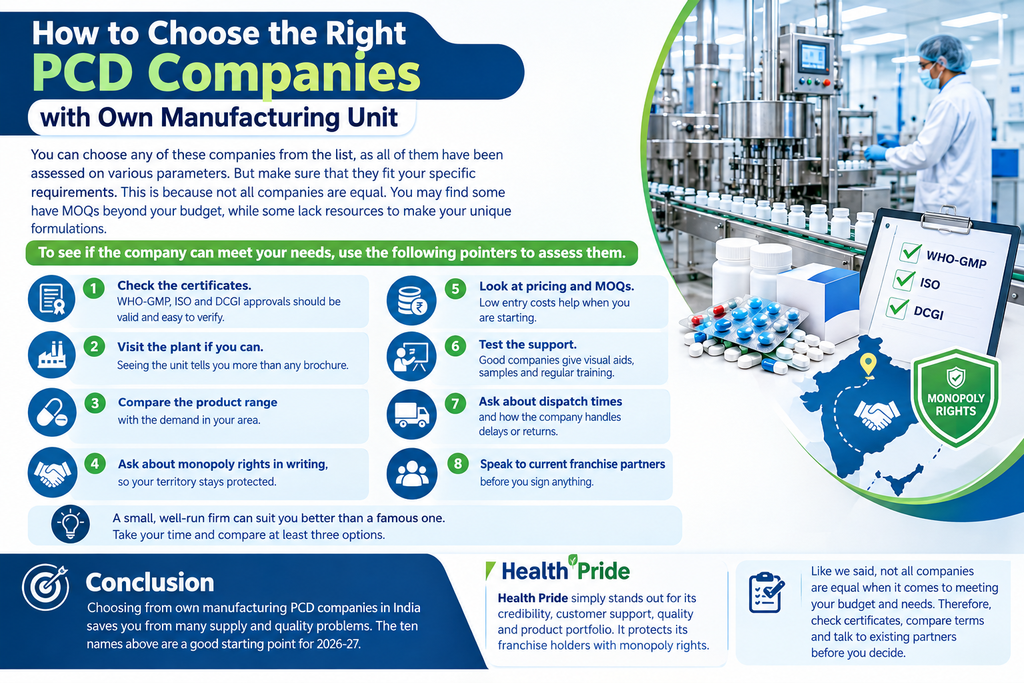
You can choose any of these companies from the list, as all of them have been assessed on various parameters. But make sure that they fit your specific requirements. This is because not all companies are equal. You may find some have MOQs beyond your budget, while some lack resources to make your unique formulations.  

To see if the company can meet your needs, use the following pointers to assess them.  

  • Check the certificates. WHO-GMP, ISO and DCGI approvals should be valid and easy to verify. 
  • Visit the plant if you can. Seeing the unit tells you more than any brochure. 
  • Compare the product range with the demand in your area. 
  • Ask about monopoly rights in writing, so your territory stays protected. 
  • Look at pricing and MOQs. Low entry costs help when you are starting. 
  • Test the support. Good companies give visual aids, samples and regular training. 
  • Ask about dispatch times and how the company handles delays or returns. 
  • Speak to current franchise partners before you sign anything. 

A small, well-run firm can suit you better than a famous one. Take your time and compare at least three options. 

How to Choose the Right PCD Companies with Own Manufacturing Unit

Conclusion 

Choosing from own manufacturing PCD companies in India saves you from many supply and quality problems. The ten names above are a good starting point for 2026-27.  

Health Pride simply stands out for its credibility, customer support, quality and product portfolio. It protects its franchise holders with monopoly rights. Like we said, not all companies are equal when it comes to meeting your budget and needs. Therefore, check certificates, compare terms and talk to existing partners. Then pick the company that matches your budget, your territory and your goals. 

Also Read :- PCD Pharma Franchise Terms and Conditions:What to Check Before You Sign

FAQs 

Q1. What does PCD mean in pharma?  

Ans. PCD means Propaganda cum Distribution. You promote and distribute a company’s products in an assigned area. 

Q2. Why choose PCD companies with their own manufacturing unit?  

Ans. You get better quality control, steadier supply and often lower prices, since there is no middleman. 

Q3. Are own manufacturing pharma franchise companies better than third-party ones?  

Ans. Often yes, because they control production and quality. Still, check each company individually. 

Q4. Which certificates should I look for?  

Ans. Look for WHO-GMP, ISO and DCGI approvals, and ask to see copies. 

Q5. Which therapeutic segments are popular?  

Ans. Antibiotics, gastro, cardiology, diabetology, dermatology, paediatrics and gynaecology are common choices. 

Q6. How do I confirm a company really owns its plant?  

Ans. Check the manufacturing licence, ask for plant photos and, ideally, visit in person. 

Q7. How do I pick the right company?  

Ans. Compare certificates, range, pricing, support and reviews. Choose the one that suits your budget and needs. 

Q8. What are the margins for a PCD franchise owner? 

Ans. In PCD pharma distribution, the profit margins normally vary between 20% and 50% depending on the therapy segment, product type and the retail strategy. 

Q9. What is the initial investment needed to start a PCD franchise? 

Ans. The starting investment can be anywhere from ₹25,000 to ₹2,000,000 depending on the product range, order quantities and the pharmaceutical partner selected.