
Monthly Archives: September 2026

PCD Pharma Franchise Terms and Conditions What to Check Before You Sign

PCD Pharma Franchise Terms and Conditions:What to Check Before You Sign

Written by the Health Pride franchise desk · Last updated 08 October 2026

Quick answer: PCD pharma franchise terms and conditions are the written rules between a manufacturer and its marketing partner. They cover six things: territory and monopoly rights, minimum order quantity, licences, pricing and payment, product range, and the agreement period with exit terms. Get the dispatch window, payment mode and monopoly rights in writing before signing.

A PCD pharma franchise agreement comes down to six things: your territory, the minimum order, your licences, how pricing and payment work, the product range, and how you exit. If you’re signing in 2026, make sure three of them are on paper before anything else: the dispatch window, the payment mode, and your monopoly rights. A verbal promise is worth nothing the day a dispute starts.

From the outside, starting a PCD franchise looks easy. Pick a company, pick a territory, start selling. The fine print is where it gets decided. Minimum order size, dispatch timelines and payment rules hit your cash flow from month one.

This guide walks through each term in plain language so you can read the agreement yourself and ask the right questions first.

What are PCD pharma franchise terms and conditions?

Takeaway: PCD pharma franchise terms and conditions are the written rules that say what you must buy, what you can sell, where you can sell it and how you pay.

PCD stands for Propaganda cum Distribution. Under this model, a manufacturer gives you the right to promote and sell its products in a fixed area, and you earn the margin on each sale. The agreement is the only thing that defines that arrangement, so reading it properly is part of the franchise process, not a formality that comes after it.

The six clauses every agreement covers

Takeaway: Most PCD pharma agreements cover territory, minimum order quantity, licences, pricing and payment, product range, and agreement period with exit terms.

Territory rights. Companies usually give you a district or a state. Check whether it’s exclusive. If it isn’t, you’ll end up competing with your own supplier’s other partners.

Minimum order quantity. Many companies set a minimum first order, and some add monthly targets. Ask what happens if you miss them.

Licences and documents. You’ll need a valid drug licence and a GST registration. Some companies also ask for a PAN card and address proof. Keep copies ready. (Link this line to your existing page on documents required to start a PCD franchise.)

Pricing and payment. The company sets the price list. Ask about margins, discounts and credit terms. New partners are usually asked to pay before dispatch.

Product range and promotion. Confirm which products are covered. Many companies supply visual aids, samples and promotional material at no charge, but get that in writing too.

Agreement period and exit. Agreements usually run one to three years. Read the renewal and termination clauses closely: how much notice each side must give, and what happens to your unsold stock if you leave.
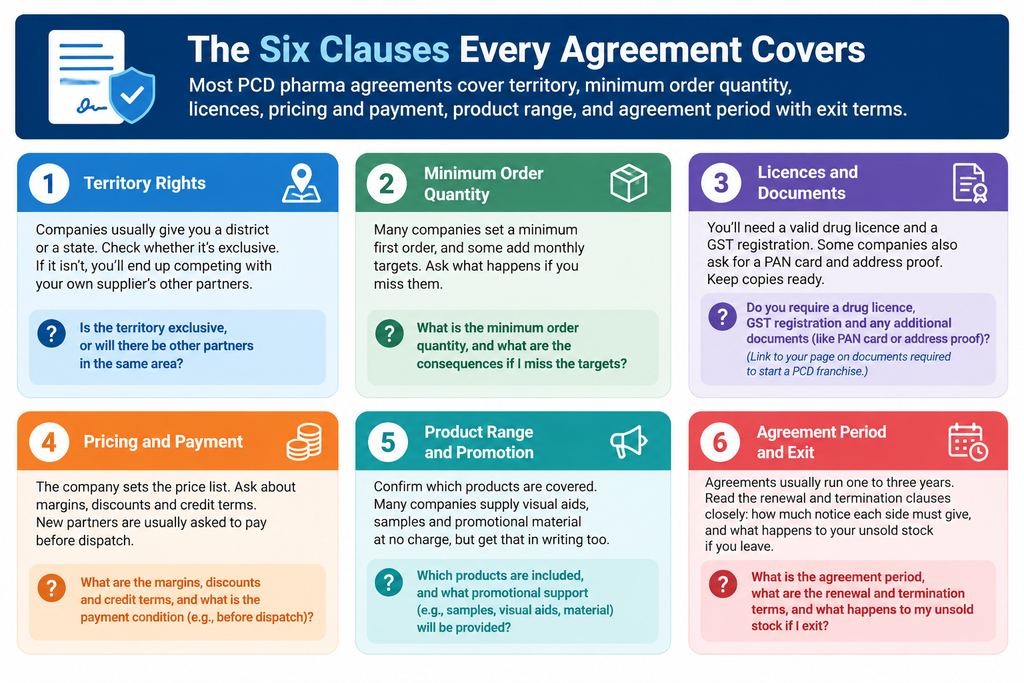
The six clauses every agreement covers

Minimum order quantity (MOQ)

Takeaway: The minimum order quantity (MOQ) in a PCD franchise is the smallest order a company will accept at one time, and it decides how much cash you lock into stock.

MOQ can be set by invoice value, number of packs or number of products. Too high, and a new partner can end up sitting on slow-moving medicines. Too low, and the company may not offer good rates or dispatch priority. You’re looking for a fair balance, not just the smallest number.

Three questions are worth asking:

  1. Is the MOQ the same for the first order and for repeat orders?
  2. Can you mix products to reach it?
  3. Will the company accept a lower figure while you build your territory?

A company that offers a flexible MOQ to new partners usually wants a long relationship. That’s a good sign.

Also check how the MOQ connects to your exclusivity. Some companies tie area rights to a yearly sales target. This is called a monopoly-based PCD franchise. Miss the target and the rights can be withdrawn, so know the number before you accept.

Warehousing and dispatch

Takeaway: A PCD franchise agreement should state a dispatch window as a specific number of working days after payment is received, not as “soon.”

After your order is confirmed, the company’s warehouse picks, packs and labels the goods. You receive an LR number or tracking ID to follow the consignment.

When the boxes arrive, check them before you sign the receipt. Look at quantity, batch numbers and the condition of the packs. Report any damage or shortage inside the time limit the agreement gives you; after that, you may have no claim. And ask about near-expiry and damaged stock now, not later, because that policy is what protects your money.

Payment terms

Takeaway: PCD pharma franchise payment terms decide your cash flow, and most new partners are asked to pay in advance, in full or in part.

Payment modelHow it worksWorth knowing
Full advanceYou pay the whole purchase order before manufacturing or dispatch.Some companies give better rates or priority handling for this. Ask rather than assume.
Part advance + CODYou pay part at order, the rest on delivery.Common middle ground for newer partners.
Credit lineA short credit period, for example 15 to 30 days, for established partners.Often backed by post-dated cheques or a bank guarantee.

Bank transfer, UPI and cheque are the usual modes. Pay only into the company’s official account, keep the proof, and make sure every payment has a matching GST invoice.

Then look for hidden costs. Packing, freight and insurance may or may not be in the quoted price, and a low rate that picks up freight at the end isn’t really low. Ask what happens if you pay late, too, because some companies hold your next dispatch until dues are cleared.

Finally, read the return and credit note rules. If a batch is defective or close to expiry, the agreement should say who takes the loss and how fast the company issues a credit note.

[Visual / Diagram Suggestion: Timeline showing order, payment, dispatch window, delivery check and credit-note deadline.]

Checklist before you sign

Takeaway: Before signing a PCD pharma franchise agreement, confirm seven points in writing, from territory rights to field support.

  • Are territory and monopoly rights written clearly in the agreement?
  • Is there a fixed dispatch window, in working days?
  • Are the payment mode, advance amount and credit period spelled out?
  • Are freight, packing and insurance charges stated?
  • Is there a clear policy for near-expiry, damaged and wrong stock?
  • Are the products WHO-GMP certified, and can you see the licence details?
  • Will you get marketing material, samples and field support?

Signs of a bad PCD pharma franchise agreement

Takeaway: One red flag in a PCD franchise agreement is reason to push back; two or more is reason to walk away.

Not every company offering you a franchise deserves your money. Some put everything in writing. Others hope you won’t ask. Scan the agreement for these:

  • Monopoly rights that stay verbal. If a company says your territory is exclusive but won’t write it down, it’s a sales pitch, not a clause. “We usually don’t give the same area to two partners” means what it says: usually.
  • A dispatch window with no number. “Soon” protects nobody. A company running a tight supply chain will name the working days.
  • Freight and packing missing from the price list. If they surface only after you order, the quote was never your real cost.
  • No written policy on near-expiry or damaged stock. If the agreement is silent, you’ll likely absorb the loss.
  • Pressure to sign today. A partner with nothing to hide expects you to read everything and compare it with another company’s terms.
  • A WHO-GMP certificate or drug licence you’re never shown. Ask to see it. An excuse instead of a document is your answer.
  • No dispute resolution clause. Without one, even a small disagreement could end up in a court far from your city, and most partners give up and swallow the loss rather than pay for that.

A company confident in its terms will write every one of these down without being asked twice.

Key takeaways

  • Six clauses define the agreement: territory, MOQ, licences, pricing and payment, product range, exit.
  • Get dispatch window, payment mode and monopoly rights in writing. Verbal promises don’t hold up in a dispute.
  • MOQ controls how much you invest in stock; ask whether it’s flexible while you build your territory.
  • Hidden freight, packing and insurance charges change your true cost.
  • Compare at least two companies before choosing.

FAQs

What does PCD stand for in pharma?

PCD stands for Propaganda cum Distribution. The company supplies the medicines, and you promote and sell them in your allotted area.

What are the main terms in a PCD franchise agreement?

Territory, contract period, product list, pricing, minimum order, payment, dispatch, returns and company support.

What is the minimum order quantity in a PCD franchise?

MOQ is the smallest order a PCD company will accept at one time, counted by value, packs or products. Check whether repeat orders carry the same figure.

Which documents are needed to start a PCD franchise?

Usually a drug licence, GST registration, PAN card, address proof and identity proof.

Can monopoly rights be withdrawn?

Yes, if the agreement links them to sales targets and you don’t meet them. Read that clause carefully.

How long does delivery take?

It depends on distance and transport mode. Ask for the dispatch window in writing.

Which payment modes are accepted?

Bank transfer, UPI and cheque are the usual ones. Always pay into the company’s official account.

Is advance payment compulsory?

It’s common, but some companies accept part payment or give regular partners a short credit period.

Are freight charges included in the price?

It varies. Ask whether packing, freight and insurance are included so you can work out your true cost.

What happens to near-expiry stock?

The agreement should state the return policy and its time limit. Check it before placing a large order.

What should I do next if a company won’t put its terms in writing?

Treat that as your answer and move on to another company. Terms that only exist verbally can’t be enforced later.

About Healthpride

Healthpride is a WHO-GMP and ISO 9001 certified PCD pharma company based in Panchkula, Haryana, with 20+ years in the industry, 180+ DCGI-approved formulations and 1,500+ franchise partners across 34 locations. The company drafts and reviews its own franchise agreements along the lines described in this guide.

Thinking about a PCD franchise in 2026? Ask Healthpride for its agreement and read these terms in writing before you sign. [Check territory availability →]

PCD Pharma Franchise Meaning Full Form, How It Works, Investment & How to Start in 2026

PCD Pharma Franchise Meaning: Full Form, How It Works, Investment & How to Start in 2026

By the Healthpride team, a WHO-GMP and ISO 9001 certified PCD pharma company in Panchkula. Checked and updated in September 2026.

Quick Answer

PCD stands for Propaganda Cum Distribution. It’s a business model where a pharmaceutical company hands an individual or small firm the right to market and distribute its medicines — under the company’s own brand — inside one defined territory, usually with monopoly protection so no second franchisee gets appointed in that same area. Entry investment typically runs ₹50,000 to ₹2,00,000, and most partners are dispensing their first order within 30 to 60 days of signing. The company handles manufacturing and regulatory compliance; you handle doctor visits, chemist relationships, and local distribution.

That’s the model in three sentences. Everything below is what you actually need to know before you sign anything.

India supplies roughly a fifth of the world’s generic medicines and a majority of global vaccine demand, per the India Brand Equity Foundation — a scale that only holds together because of a distribution network built almost entirely on franchise partnerships, not company-owned outlets. The PCD model is how most of that network actually gets staffed. If you’ve read the term and weren’t sure whether it’s a license, a contract, or a type of company, you’re asking the right question — most first-timers get this wrong before they get it right.

What Does PCD Stand For?

Propaganda Cum Distribution. It’s an Indian-industry-specific term with no real equivalent abroad, which is part of why it confuses people searching from outside the country. “Propaganda” here just means promotion — the older, pre-marketing-jargon word for it — not anything sinister.

The term is dated. The model isn’t. Below the top 20–30 branded pharma companies in India, the overwhelming majority of prescription-brand sales move through PCD partnerships rather than company-employed sales forces.

What Is a PCD Pharma Franchise, Really?

It’s a contract where a manufacturer lets a franchisee market and sell its medicines, under the manufacturer’s brand, inside a specific territory. Three things separate it from an ordinary distributorship:

A defined territory — a district, a city, sometimes a full state. Monopoly basis — no second PCD partner appointed inside that territory for the same products. A fixed product list — you pick from the manufacturer’s catalogue rather than negotiating custom formulations.

The arrangement works because it solves a problem for both sides. The manufacturer gets a committed local partner without hiring and managing a sales force. The franchisee gets a real product line and brand backing without the capital or licensing burden of manufacturing anything themselves.

How the Model Works, Step by Step

  1. The manufacturer produces medicines at a WHO-GMP certified facility.
  2. You sign a franchise agreement covering your territory and product list.
  3. You get monopoly marketing rights for that territory.
  4. The company supplies promotional material — visual aids, sample kits, literature.
  5. You build doctor relationships, generate prescriptions, and take orders from chemists.
  6. The company fulfils stock; you distribute to retailers, hospitals, and clinics.

None of this is glamorous. It’s mostly meeting the same 30–40 doctors on a rotation, keeping chemists stocked, and chasing payment cycles — which is exactly what makes it approachable for anyone who’s already worked as a medical representative or run a pharmacy counter.

PCD Franchise vs Third-Party Manufacturing

People conflate these constantly. They’re not close to the same thing.

ParameterPCD Pharma FranchiseThird-Party Manufacturing
What you’re doingMarketing and distributionManufacturing under your own brand
Typical investment₹50,000 – ₹2,00,000₹5 lakh+ minimum order
Brand on the productManufacturer’s brandYour brand
Time to first sale30–60 days4–6 months
Best fitFirst-time entrepreneurs, MRs going independentEstablished players building their own brand
Regulatory burdenLighter — manufacturer holds the manufacturing licenseHeavier — you own the product’s compliance

If you want to be selling something inside two months with minimal capital, PCD is the faster door. If you want your own brand on the box and you have the capital and patience to build it, third-party manufacturing is the right conversation to have instead.

Who Should (and Shouldn’t) Start One

You legally need:

  • A drug license — Wholesale (Form 20B/21B) or Retail, per rules set by the Central Drugs Standard Control Organization (CDSCO).
  • GST registration — non-negotiable for any pharma trading activity.
  • Working capital — realistically ₹50,000 to ₹2,00,000 depending on territory size and product range.

Beyond the paperwork, the people who actually succeed at this tend to have one of three backgrounds: 2+ years as a medical representative, a pharmacy degree (B.Pharm/D.Pharm), or hands-on chemist or distributor experience. This is a relationship business before it’s anything else — doctors prescribe brands they trust, and trust is built by the person who keeps showing up, not by the brochure.

If you don’t have any of that background and you’re not willing to put in the doctor-visit grind yourself, be honest about it before you sign — the model punishes absentee operators badly.

Investment: What It Actually Costs

There’s no single number here, and any company that quotes you one flat figure without asking about your territory or product basket is oversimplifying. What actually moves the total:

Cost AreaWhat It Covers
Initial stockMedicines chosen for your territory and MOQ
Licensing & registrationDrug license, GST, PAN, business paperwork
StoragePremises suitable for pharmaceutical stock
PromotionVisual aids, sample kits, launch marketing
TransportGetting stock from warehouse to chemist
Working capitalCovers the 30–60 day payment cycle most chemists run on

Ask for a current product price list, the MOQ, and payment terms before you try to estimate your total investment — not after. A company that hesitates to put these in writing before you commit is telling you something about how they’ll behave after.

Documents You’ll Need

Requirements shift slightly by state and business structure, but the core list is consistent:

  • Drug license (Wholesale or Retail, matching your operating scope)
  • GST registration certificate
  • PAN card
  • Aadhar or other identity/address proof
  • Business/entity registration, if applicable
  • Proof of address for business premises
  • Bank account details
  • Storage/premises documentation
  • Signed franchise or distribution agreement specifying territory, products, and monopoly terms

Confirm the current requirement list for your specific state before you start — rules do get updated, and a five-minute check with your local drug control office saves a rejected application later.

What Products Come Under a PCD Franchise

Portfolios vary by manufacturer, but a reasonably complete PCD catalogue usually spans:

Tablets, hard gelatin capsules, softgels, syrups, suspensions, dry syrups, injections, ointments, gels, drops, nutraceuticals, and therapy-specific ranges across antibiotics, gastrointestinal, gynaecology, cardiac-diabetic, dermatology, paediatrics, and orthopaedics.

A wider catalogue isn’t just a vanity metric — it’s what lets you expand into a second or third therapy segment later without switching manufacturers, which is a real advantage once your first segment matures and growth slows.

Monopoly Rights: What to Verify Before You Sign

“Monopoly” gets used loosely. Before you treat it as a done deal, pin down, in writing:

  • The exact geographic boundary — a district isn’t the same as a talukas-level breakdown, and companies sometimes leave this vague on purpose.
  • Which products the monopoly actually covers — the full catalogue, or a narrower list?
  • Duration and renewal terms.
  • Any mandatory minimum purchase requirement to keep the monopoly active.

A verbal assurance of exclusivity is not exclusivity. If it’s not in the agreement, it doesn’t exist.

How to Start: The Real Sequence

  1. Understand the model fully — what’s supplied, what’s expected of you, how territory gets decided.
  2. Pick a therapy segment that fits what actually sells in your area — general range, cardiac-diabetic, gynae, paediatric, dermatology, ayurvedic, or a tighter niche.
  3. Walk your own market before committing capital — which brands are moving, what doctors are already prescribing, where the gaps are.
  4. Shortlist companies on product quality, certifications, years in operation, and the honesty of their commercial terms — not just on price.
  5. Verify certifications yourself — WHO-GMP, ISO 9001, DCGI approval, FSSAI where relevant. Ask for certificate copies. A website badge proves nothing.
  6. Negotiate terms in writing — MOQ, payment schedule, promotional support, monopoly clause, return policy for expired or damaged stock.
  7. Sign, register, launch — get your license and GST sorted if you haven’t already, place your first order, start doctor visits.

Total timeline from signature to first dispatch: 30 to 60 days if your licenses are already in place. Longer if they’re not — get that sorted first, not in parallel.

Where the Opportunity Is Strongest Right Now

Territory availability shifts constantly as companies appoint new partners, but the broad regional picture looks like this:

  • North India — Chandigarh, Punjab, Haryana, Himachal Pradesh, Delhi NCR, Uttar Pradesh, Uttarakhand, Rajasthan
  • West India — Gujarat, Maharashtra, Madhya Pradesh, Goa
  • South India — Telangana, Andhra Pradesh, Tamil Nadu, Karnataka, Kerala
  • East India — West Bengal, Odisha, Bihar, Jharkhand
  • Northeast — Assam and the wider Northeast cluster

North India’s tri-city belt — Chandigarh, Panchkula, Mohali — deserves a specific mention: it sits close to a dense manufacturing base in Baddi and Solan, which means shorter supply lines and generally tighter delivery timelines than franchisees further from the manufacturing cluster get.

What Separates a Good PCD Company From a Risky One

Run any shortlist through these filters before you sign:

  • Certifications — WHO-GMP, ISO 9001, DCGI, and FSSAI where relevant. Ask for copies, not claims.
  • Catalogue breadth — a company with 300+ products across multiple therapy areas gives you room to grow without switching partners.
  • Years in the business — a decade or more usually signals a supply chain that’s already survived a few rough patches.
  • Promotional support quality — look at an actual sample visual aid before you sign, not a description of one.
  • Pricing transparency — net rates in writing, not “we’ll discuss it after you commit.”
  • Written monopoly terms — see the section above. Non-negotiable.

Where This Goes Wrong (and How to Avoid It)

Building a doctor base from zero. Don’t try to cover fifty doctors in month one. Pick 30–40 high-prescription doctors, visit weekly, and prioritise the relationship over the pitch — the order follows the trust, not the other way round.

Managing the payment cycle. Chemists routinely take 30–60 days to pay. Keep roughly 1.5× your monthly inventory cost as a buffer, and don’t extend credit past 45 days to a new account you haven’t tested yet.

Standing out in a crowded segment. General range and cardiac-diabetic are saturated in most cities. A tighter combination — nephrology plus urology, or specialty injectables — usually means less competition and more room to actually build a name.

Why Partner With HealthPride

[This section should be completed with HealthPride’s actual, verifiable details before publishing — do not publish placeholder claims as fact. Suggested structure below.]

Health pride offers PCD pharma franchises on a monopoly basis across India. The catalogue has 180+ DCGI-approved formulations in four segments: allopathic, Ayurvedic, pediatric and nutrition. Manufacturing is WHO-GMP and ISO 9001 certified, and the company has been in the industry for over 20 years. Today, 1,500+ franchise partners work with Health pride across 34 locations.

What we’d recommend highlighting here, once verified:

  • Current, valid certifications with dates
  • Actual product range and therapy segment count
  • Real years of operating history
  • Specific regions where monopoly territory is currently open
  • Any concrete evidence of franchisee support (sample visual aids, a real case study, a named contact)

Looking for a reliable PCD pharma franchise partner? Apply for a HealthPride PCD Franchise →

Frequently Asked Questions

What is the full form of PCD in pharma?

Propaganda Cum Distribution — a franchise model where a manufacturer authorises a partner to market and distribute its medicines under its own brand, in a defined territory.

What is the minimum investment for a PCD pharma franchise?

Most operations start with ₹50,000 to ₹2,00,000 in working capital. The real number depends on territory size, product range, and the manufacturer’s MOQ — get a specific quote rather than budgeting off a general range.

Is a drug license mandatory?

Yes. A Wholesale Drug License (Form 20B/21B) or Retail License, depending on your state and scope, per CDSCO rules. GST registration is also mandatory.

How is a PCD franchise different from third-party manufacturing?

PCD is marketing and distribution of someone else’s branded product. Third-party manufacturing is contracting a manufacturer to produce a product under your brand. PCD costs less and launches faster; third-party manufacturing gives you brand ownership at a higher entry cost and longer timeline.

Can I actually get monopoly rights?

Yes, from most established companies — but confirm territory boundary, product coverage, duration, and renewal terms in writing before you treat it as settled.

Which therapy segments perform best right now?

Cardiology, diabetology, dermatology, gynaecology, and paediatrics consistently show strong demand. Niche combinations like nephrology-urology or specialty injectables face less competition if you’re trying to differentiate rather than compete head-on in a crowded segment.

How long does setup actually take?

30 to 60 days from signing to first dispatch, assuming your drug license and GST are already sorted. If they’re not, get those first — don’t try to run them in parallel with franchise negotiations.

What documents does the franchise agreement itself need to cover?

Territory definition, full product list, monopoly terms (if any), MOQ, payment terms, promotional support commitments, and a return policy for damaged or expired stock.

Is the PCD pharma business actually profitable?

There’s no guaranteed margin — it depends on product demand, your pricing, operating costs, inventory turnover, and how well you actually work your territory. Companies that promise a fixed return figure upfront should be treated with suspicion.

What’s a realistic profit margin to expect?

No standard number exists across the industry. Actual returns depend on purchase pricing versus sale pricing, discounts, taxes, inventory movement, and local market conditions — ask for a real worked example from any company you’re seriously considering, not a general percentage.

Also Read:- PCD Pharma Franchise Terms and Conditions:What to Check Before You Sign

About this guide

The Healthpride team wrote and checked this guide in September 2026. We’ve been in pharma for 20+ years, with 180+ DCGI-approved formulations and 1,500+ franchise partners across 34 locations, so the advice here comes from the work we do every day.

Treat the costs and document lists as a starting point. They change by state and by company, so confirm them with the company and your local drug licensing office before you pay anything.

Check territory availability →

References

  1. India Brand Equity Foundation (IBEF). Pharmaceutical Industry in India. https://www.ibef.org/industry/pharmaceutical-india
  2. World Health Organization (WHO). Good Manufacturing Practices for Pharmaceutical Products. https://www.who.int/teams/health-product-and-policy-standards
  3. Central Drugs Standard Control Organization (CDSCO), Ministry of Health & Family Welfare, Government of India. Drug Licensing Framework. https://cdsco.gov.in/opencms/opencms/en/Drugs/
  4. Drugs Controller General of India (DCGI), CDSCO. https://cdsco.gov.in/opencms/opencms/en/Home/

Last updated: September 2026.


/

PCD Pharma Franchise Company in India: Trusted & Affordable Franchise Partner 2026

Best PCD Pharma Franchise Company in India: Trusted & Affordable Franchise Partner 2026 

In a PCD pharma franchise, the company makes the medicines and you sell them, exclusively, in your district or state. PCD stands for Propaganda cum Distribution. Getting started in 2026 usually costs somewhere between ₹50,000 and ₹1,00,000, depending on the range and the minimum order. One rule before you sign: see the WHO-GMP and ISO certificates yourself, and get your monopoly rights and a small first order into the agreement. Verbal promises don’t count.

Choosing the right PCD pharma franchise company in India can decide whether your first year in pharma is smooth or stressful.  

Choosing the right PCD pharma franchise company in India

A good partner sends quality medicines on time, protects your area and backs your sales. A poor one leaves you with late orders, vague terms and stock that will not sell.  

This guide explains how the model works, what it costs and how to apply in 2026. It also shows why Healthpride deserves a serious look. 

What is a PCD Pharma Franchise

What is a PCD Pharma Franchise Company in India? 

A PCD pharma franchise company manufactures branded medicines and gives you the exclusive right to sell them in a set area, usually a district or a state. PCD means Propaganda cum Distribution. The company deals with production, quality checks and regulatory work. You do the promotion and the selling. No factory needed.

PCD is short for Propaganda cum Distribution.  

A PCD pharma franchise company manufactures branded medicines and allows its partners to sell the medicines in a specific territory like a district, city or state. In this business model, the parent pharmaceutical company takes care of the complicated manufacturing, quality assurance, packaging and regulatory processes. 

The franchise partner, on the other hand, is responsible for promoting and selling the products in the territory assigned to them.  

This makes a win-win partnership on both sides with balanced benefits. Small business owners have less risk, and parent companies have more reach in the market. 

Why Start a PCD Pharma Franchise

Why Start a PCD Pharma Franchise in India in 2026? 

The success of a PCD pharma franchise in India is driven by several reasons.  Because the demand is no longer only a big-city story, and you can get in for a fraction of what a factory costs. Smaller towns now have clinics and pharmacies hunting for dependable suppliers. Chronic conditions like diabetes bring the same patients back every month. And since the company hands you a finished product range, you can start in one district and stretch out once it works.

  • Demand for medicines keeps growing, and it is no longer limited to big cities.  
  • Clinics and pharmacies in smaller towns need dependable suppliers, and long-term conditions such as diabetes create steady repeat orders.  
  • The model also costs far less than building a factory.  
  • A reliable PCD pharma franchise company in India gives you a ready range of products from day one. That’s why you can begin with a single area and grow from there. 

Basically, a PCD pharma franchise aims to fulfil the ever-increasing demand for medicines among healthcare facilities, doctors, and pharmacists. A heavy demand for medicines translates to big profits.  

How to Choose a Trusted PCD Pharma Franchise Company

How to Choose a Trusted PCD Pharma Franchise Company 

Check these before you pay a rupee:

  • WHO-GMP and ISO certificates. Ask to see them, not just hear about them.
  • Monopoly rights in writing, with your territory spelled out.
  • How they answer questions. Quick and honest is good. If a company hesitates to put a promise on paper, that tells you plenty.
  • A flexible MOQ, so your first order doesn’t sink you.
  • A supply chain that actually delivers on time.

Every PCD pharma franchise company in India says it is reliable, so check the facts yourself.  

Look for WHO-GMP and ISO Certificates 

A trusted company has WHO-GMP and ISO certificates in place. These certifications assure that the company follows international standards of manufacturing.  

Clear Monopoly Terms 

Monopoly rights help you grow your business without competition. They establish you as a sole vendor of the company’s products in a certain area. The company doesn’t allow another vendor to operate in that area. A good company will provide clear monopoly rights in writing.  

Customer Support: 

Notice how the team answers your questions. Prompt, honest replies are a good sign. Ask for every promise in writing, and remember that the best PCD pharma franchise company will not mind. 

Flexible MOQs: 

Not all franchise partners can afford big orders. A good company has flexible MOQs in place to let their partners start with the required number of batches.  

Timely Delivery 

Delivery matters the most when it comes to fulfilling the demand for medicines in emergencies. A reliable company has a robust logistics and supply chain system in place.  

Key Features of an Affordable PCD Pharma Franchise Company 

What are the Key Features of an Affordable PCD Pharma Franchise Company 

An affordable PCD franchise gets you in cheaply without weakening the product. Look for:

  • A modest investment
  • Flexible minimum orders
  • Competitive pricing with decent margins
  • Marketing support that’s either free or priced upfront
  • Terms with no hidden charges

One warning: don’t pick on price alone. A cheap range from a weak manufacturer will cost you more in returns and lost trust than you ever saved.

An affordable PCD pharma franchise company keeps the cost of entry low without cutting quality. Look for these attributes:  

  • Offering reasonable investment requirements 
  • Keeping their MOQs flexible  
  • Keeping the pricing competitive 
  • Offering attractive margins 
  • Providing marketing and promotional support 
  • Using transparent business terms with no hidden charges 

Price alone should never decide the matter. Cheap medicines from a weak maker cost more in returns and lost trust. 

PCD Pharma Franchise Investment and Cost in India 

Most PCD franchises in India cost between ₹50,000 and ₹1,00,000 to start. Where you land in that range depends on the company, the product list, the minimum order and your territory. My advice is to start small, with 15 to 20 products doctors already ask for. Then let your first sales pay for the niche ranges.

There is no fixed price, because the cost depends on the company, the range and your area. The number of products and the minimum order also shape your budget. It may cost you anywhere between 50,000- 1,00,000 to start your PCD pharma franchise.  

The main costs are these: 

How to Develop a Realistic Franchise Budget 

Don’t order too big an inventory at the start; begin with 15 to 20 products in high demand. Use first sales proceeds to build out your portfolio into niche therapeutic areas over time. 

How to Apply for a PCD Pharma Franchise in India 

Applying takes five steps:

  1. Pick a segment and shortlist companies. Choose a range that matches the doctors you can meet regularly, then compare licences and reputation.
  2. Lock down your territory. Ask for written proof the area is free and how its borders are drawn.
  3. Send your details. Your contact information, any medical-field experience and the area you want.
  4. Go through the product list and pricing. Margins, MOQ, credit period, shelf life, transport charges. The last two eat into profit more than people expect.
  5. Sort the paperwork and sign. Usually a drug licence, GST number, ID proof, address proof and a photo.

Once you have picked a PCD pharma franchise company in India, it usually runs as follows. 

Identify the Right Company and Therapeutic Segment 

Begin by deciding which medicines you want to sell, because that choice shapes everything else.  

Think about the doctors you can meet often. For example,  

  • If you know many general physicians, general medicines will suit you.  
  • If your contacts are mostly skin specialists, a dermatology range makes more sense.  

Shortlist a few companies in that segment and compare their licences, papers and name in the market. If you can, speak to two or three current franchise holders and ask how supply, payment and support work in real life. Their honest views will tell you far more than any brochure. 

Check Available Territories 

Area is the heart of a PCD franchise, so ask about it early. 

Good districts are taken quickly, and a company can only give sole rights in places that are still free. Tell the company where you already have contacts, and ask for written proof that the area is vacant.  

Ask how it marks its borders and what happens if another partner works nearby. A clear answer now prevents disputes later.  

It also lets you plan your visits, your stock and your budget around one fixed area, which makes your first months far less stressful. 

Submit Required Business Details 

Next, send the company a short profile of yourself and your plans. Most companies ask for your name, address, phone number, email and the area you want. They may also ask about your work in the medical field and how many doctors and chemists you hope to reach.  

Keep every detail true and clear, because the company uses it to decide if you are a good fit and to give you an area. A well-prepared profile shows that you are serious, and companies tend to reply faster when the details are complete. Keep a copy of everything you send. 

Review Product List and Pricing 

Ask for the full product list, with the price and margin on each item. Check how many products you must order to begin, and whether the minimum order is low or flexible. Look at packing, shelf life and payment terms too.  

Credit periods and transport charges change your real profit. Compare the prices with similar brands in your market to see whether you can compete.  

If anything is unclear, ask for it in writing. A good company will explain every figure with patience and will never push you to decide in a hurry, so take your time here, ince this step sets your profit. 

Complete Documentation 

Documents Required for a PCD Pharma Franchise

You’ll normally need:

  • A drug licence (a wholesale licence if you’ll be distributing)
  • A GST certificate
  • ID proof and address proof
  • A passport-size photograph
  • The signed franchise agreement

The exact list shifts from state to state, so confirm with your local drug licensing office before you start collecting.

Once you are happy with the terms, you can move on to the papers.  

The list depends on your state and the company.  

Read it with care before you sign, and keep a copy for your records. Ask about any clause you do not understand. When the papers are in order, you can place your first order and start visiting doctors and chemists. 

Why Healthpride is Your Trusted PCD Pharma Franchise Company in India 

Healthpride is built for people who want quality products, an exclusive area and a low barrier to entry. Here’s what’s on the table:

  • DCGI-approved formulations in tablets, capsules, syrups, injectables and ointments, with quality checks on each batch
  • True monopoly rights in your allotted territory
  • Promotional kits: visual aids, physician samples, reminder cards, product cards and gifts
  • Low MOQs, fair pricing and strong margins
  • On-time delivery, plus a support team that helps from choosing your product mix to answering sales questions

Healthpride offers franchise partnerships to people who want quality products, fair terms and steady support. It is a reliable PCD Pharma franchise company in India by keeping its terms simple and its supply reliable.  

Quality-Focused Products 

Healthpride has a large portfolio of DCGI-approved formulations in the form of tablets, capsules, syrups, injectables and ointments. Strict quality control checks are carried out on every batch. 

True Monopoly Rights 

You can build your distribution network without worrying about internal competition within your allocated territory. 

Unbeatable marketing and promotional support 

Healthpride has complete promotional kits to help you close leads faster. It provides high-quality visual aids, physician samples, reminder cards, product cards and custom gifts. 

Transparent & Fair Pricing Structure 

Healthpride is a Low-cost PCD Pharma Franchise Company with high profit margins and low MOQs. You can start your business without a lot of financial pressure. 

On-Time Delivery and Solid Supply Chain 

Stock-outs lose customers; Healthpride understands. The streamlined distribution system makes sure that orders are sent out smoothly and on time. 

Customer and Business Guidance 

Healthpride is one of the leading PCD Pharma Franchise Companies in India, with an expert support team guiding you at every step, right from selecting the right product mix to solving your sales queries. 

How to Apply for a PCD Pharma Franchise in India

Conclusion 

The right partner can turn a PCD franchise into a steady business. Check licences, compare prices and ask for written terms. Compare each Top PCD pharma franchise company in India on quality, supply and support, and choose the one that answers your questions clearly. 

An affordable PCD pharma franchise company that delivers good medicines on time beats a cheap offer with no support. If you are ready to begin in 2026, contact Healthpride to ask about area availability, product lists and terms. 

FAQs 

Q1. How much investment is needed to start a PCD pharma company? 

Ans. While it can be anywhere between INR 50,000-INR 1,00,000, the amount varies by company, product range and area. Ask for the price list and minimum order in writing before you decide. 

Q2. Is a drug licence required? 

Ans. In most cases, yes, because you need one to stock and sell medicines. Check the rules for your state with the local licensing office. 

Q3. What are monopoly rights? 

Ans. Monopoly rights mean the company will not give the same products to any other partner in your agreed area for as long as the agreement runs. 

Q4. How do I know if a pharma company is trustworthy? 

Ans. Ask for its licence, certificates and partner references, and make sure that price, supply and area terms are all written into the agreement. 

Q5. What margins can I expect? 

Ans. Margins differ by product and company. Ask for a written price list, then work out your profit after travel and promotion costs. 

Q6. Do PCD companies give marketing support? 

Ans. Generally, most companies provide it. It can include samples, visual aids, leaflets and product training, though the range of help differs from one company to another. However, make sure to ask if the support is free or priced.  

Q7. Which pharma segments are popular? 

Ans. General medicines, women’s health, skin care, child care, bone health and nutrition are common choices. Pick the one that best suits the doctors you meet. 

Q8. How long does it take to get started? 

Ans. Once your papers are ready and the agreement is signed, you can usually place a first order within a few weeks. Licence time varies by state. 

Q9. an I take more than one district? 

Ans. Many companies allow it. Much depends on your sales record and on whether the extra area is still free. 

Q10. Is GST registration required for pharma PCD franchise? 

Yes, if your sales or business type calls for it. Most partners register so that they can issue proper bills to chemists and hospitals. 

Q11. Which documents are usually required for a pharma PCD franchise? 

Ans. Common papers are a drug licence, GST certificate, ID proof, address proof, a photograph and a signed franchise agreement. 

Google Preferred Sources

Contact Health  pride

Top 10 Pharmaceutical Companies in India for Franchise Business

Top 10 Pharmaceutical Companies in India for Franchise Business 

Top 10 Pharmaceutical Companies in India for Franchise Business

  1. Healthpride (Panchkula)
  2. Agex Laboratories Pvt. Ltd. (Gurugram)
  3. Radius Healthcare Pvt. Ltd. (Ahmedabad)
  4. Biogem Healthcare (Jaipur)
  5. Burnet Pharmaceutical (Kolkata)
  6. Novalife Healthcare (Bangalore)
  7. Aconwell Pharma (Ambala)
  8. JM Laboratories (Solan)
  9. Janus Biotech (Chandigarh)
  10. Vysali Pharmaceuticals Limited (Kochi)

If you are looking for a pharma franchise across India, there are plenty of pharma companies you can choose from. However, not all of them are the same. They vary based on pricing, monopoly rights, marketing support, and delivery timelines. Market reputation also matters.  

Keeping such concerns in mind, we have picked the top 10 pharmaceutical companies in India for franchise business.  

Why Picking the Right Pharmaceutical Company in India Matters 

Not every PCD pharma firm treats its partners the same way. Some give you monopoly rights over your whole district. Others make you compete with five other distributors in the same town. Some ship your stock in 48 hours. Others make you wait two weeks. 

A good pharmaceutical company in India gives you exclusive territory. It offers fair pricing. It backs you with real promotional support, like visual aids, MR bags, and sample kits. A company that doesn’t fit your requirements may be a waste of time and money. That’s why you should invest time and effort to find the right one.  

pharma  Company

Top Pharma Franchise Companies in India – Compare Monopoly Rights, Certifications & Delivery

Company Location Certifications Monopoly Rights Product Range Delivery Time
Healthpride Panchkula WHO-GMP, ISO 9001 Yes, pan-India 180+ formulations 3-5 days
Agex Laboratories Gurugram ISO certified Yes, regional Derma, ortho, baby drops 5-7 days
Radius Healthcare Ahmedabad GMP compliant Yes General, cardio, nutraceuticals 5-7 days
Biogem Healthcare Jaipur GMP compliant Yes, full Softgels, tonics, tablets, creams 5-7 days
Burnet Pharmaceutical Kolkata GMP compliant Yes, exclusive General, neuro-care, metabolic 5-7 days
Novalife Healthcare Bangalore WHO-GMP, ISO 9001:2015, FSSAI, HACCP Yes, district-level 400+ formulations 48 hours
Aconwell Pharma Ambala WHO-GMP, ISO 9001:2015 Yes Tablets, syrups, injections, capsules 5-7 days
JM Laboratories Solan WHO-GMP, ISO Yes Tablets, capsules, syrups, powders 5-7 days
Janus Biotech Chandigarh WHO-GMP Yes, sole Heart-diabetic, bone care, general health 5-7 days
Vysali Pharmaceuticals Kochi GMP compliant Yes Antibiotic dry syrups, baby liquids 5-7 days

Delivery timelines are as reported by each company and may vary by location and order size.

What are the Top Pharma Franchise Companies in India 

 1. Healthpride (Panchkula) 

Healthpride holds WHO-GMP and ISO 9001 certification. It is based in Panchkula, Haryana.  

With more than 20 years of rich industry experience and an active presence at 34 locations across India, the firm has over 1,500 happy clients. They have a wide range of more than 180 quality formulations, like pharmaceutical tablets, capsules, injections, syrups, dry syrups, ointments, soaps and some special Ayurvedic products. They provide lucrative PCD pharma franchise opportunities on a strict monopoly basis all over the country. 

Healthpride

 2. Agex Laboratories Pvt. Ltd. (Gurugram) 

Agex Laboratories focuses on dermatology, orthopaedics, and baby drops. That location works in your favour. It offers exclusive regional rights and clear pricing. The company offers a wide range of products to independent medical reps.  

Their franchise plans come with monopoly rights, transparent pricing, attractive packaging and flexible order quantities.   

 3. Radius Healthcare Pvt. Ltd. (Ahmedabad) 

Radius Healthcare provides a full spectrum of modern medical needs with a strong focus on general medicine, cardiovascular drugs and advanced nutraceutical supplements.  

Their franchise partners enjoy the benefits of modern leak-proof packaging, all marketing tools and multi-purpose product lines for fast market growth. 

 4. Biogem Healthcare (Jaipur) 

Biogem Healthcare is based in Jaipur. It covers softgel capsules, health tonics, tablets, and creams. The firm has earned a solid name for its quality products, steady delivery and clear policies. They offer full monopoly rights for your area. You also get marketing tools like MR bags and product literature to help you sell.  

 5. Burnet Pharmaceutical (Kolkata) 

6. Novalife Healthcare (Bangalore) 

Novalife Healthcare has grown fast, and it shows. It holds WHO-GMP, ISO 9001:2015, FSSAI, and HACCP certification. The firm offers more than 400 formulas. These span cardiac, diabetic, bone, child, skin, and general health ranges. Its high-margin model comes with district-level monopoly rights. It also promises 48-hour stock dispatch, which is rare in this space. Add visual aids and full MR kits, and it’s easy to see why reps rate Novalife among the best pharma franchise company options in India today. 

 7. Aconwell Pharma (Ambala, Haryana) 

Aconwell Pharma holds WHO-GMP certification. It has grown on strict quality control alone. Every batch meets national and global rules. This ISO 9001:2015-certified firm handles manufacturing, research, and marketing.  

It covers tablets, syrups, injections, and capsules. The company’s focus spans heart care, general medicine, child care, women’s health, and critical care.  

8. JM Laboratories (Solan, Himachal Pradesh) 

JM Laboratories has been running since 2006. It has quietly built a name as a steady manufacturer. Both ISO and WHO-GMP back its work. Its range covers tablets, capsules, syrups, and powders. The firm has a real stronghold in heart health, diabetes, and infection care. These three areas never go out of demand. 

 9. Janus Biotech (Chandigarh) 

Janus Biotech focuses on heart-diabetic care, bone care, and general health supplements. It is a WHO-GMP certified facility. Its model offers sole monopoly rights. So partners aren’t fighting for the same buyers in a crowded market. You also get visual aids, sample covers, order books, and gifts as standard. It’s built for partners who want to compete seriously in their region. Among the best pharmaceutical franchise companies in India, Janus Biotech stands out for its women’s health and speciality range too. 

 10. Vysali Pharmaceuticals Limited (Kochi, Kerala) 

Vysali Pharmaceuticals is located near Kochi’s trade hub. It offers antibiotic dry syrups and baby liquid drops, among other items. Its flexible franchise is easy to enter and budget-friendly as well. That suits new distributors well. Thanks to high production standards, partners find it easy to build trust with local doctors. 

How to Choose the Right Franchise Company 

Every company featured on this list is reviewed on parameters like certifications, pricing, feedback and reputation. However, you also need to review them for the same factors. This is because corporate policies, industry standings, and product categories may change over time. Whether you are choosing from the list or outside of it, make sure to review them on the following factors.  

  • Start by checking the certifications. WHO-GMP and ISO 9001 show the plant meets a real standard.  
  • Next, look at the product range. Does it match what doctors in your area actually prescribe?  
  • Ask about monopoly rights in plain words. Will you really be the only seller in your district? Or is that just a sales line?  
  • Check delivery times too. A firm that takes two weeks to send stock will cost you sales.  

Every honest pharmaceutical company in India will share these facts upfront, without you having to push. Finally, talk to current franchise partners if you can. Their word tells you more in five minutes than any sales pitch will in an hour. 

Final Thoughts 

India’s pharma franchise market isn’t slowing down any time soon. The firms above give you a real mix: big monopoly names, regional experts, and newer firms still building their name. Whichever pharmaceutical company in India you shortlist, do your homework first. Check the certifications. Check the territory rights. Check the support on offer. A good partner makes your first year in business far smoother than a bad one ever could. 

Frequently Asked Questions 

Q1. What is a PCD pharma franchise? 

Ans. It’s a model where a pharma firm lets you sell its products in a fixed area. You use its brand name and get its marketing support. You handle the local sales and delivery. 

Q2. Do I need a pharmacy degree to start a franchise? 

Ans. No, you don’t need a pharmacy degree. You will usually need a drug licence, though. Many owners come from a sales or medical rep background. 

Q3. What documents are required for a PCD pharma franchise? 

Ans. You’ll need GST registration, a drug licence, and your Aadhaar and PAN card. Some states also ask for a shop licence. 

Q4. Are monopoly rights guaranteed with every franchise company? 

Ans. Not always. Some pharmaceutical franchise companies in India offer strict monopoly rights. Others allow more than one seller in the same area. Always get this in writing before you sign. 

Q5. Can I run a franchise part-time alongside another job? 

Ans. It’s possible at first. But this business needs regular visits to doctors and chemists. Most owners end up running it full-time. 

Q6. How do I verify if a pharma company is genuine? 

Ans. Check their WHO-GMP and ISO marks. Ask for their drug licence. Look up client reviews, and visit their plant if you can before you sign. 

Q7. Can I start a franchise business without any prior experience as a Medical Representative? 

Ans. Yes, sales experience is useful but not absolutely required. A lot of companies help new partners with full product training, marketing literature and promotional strategies. 

Q8. How do the leading manufacturers ensure that the orders are delivered fast in different states? 

Ans. The leading companies have strategically located regional logistics centres, automated warehousing systems and agreements with reliable courier services to guarantee stock delivery in 24 to 48 hours. 

How to chosoe  the Right Pharma Company
Google-Preferred Sources

Top 10 General Range Pharmaceutical Companies in India 

Top 10 General Range Pharmaceutical Companies in India 

Healthpride, based in Panchkula, Haryana, is the top general range pharma company in India in 2026. It’s WHO-GMP and ISO 9001 certified, covers nine product categories — tablets, capsules, injectables, syrups, suspensions, ointments, soaps, and herbal remedies — and offers monopoly-based PCD franchises with full marketing support. For businesses that want breadth plus certification in one package, it’s the safest starting point on this list.

For any PCD franchise or a distribution business, general range medicines can ensure steady profit. They sell year-round, don’t need heavy promotion, and every doctor prescribes them regardless of specialisation. A well-chosen general range pharmaceutical company in India gives you a stable base to build on, even if you later branch into speciality segments like oncology or cardiology. 

If you’re looking to start a franchise, tie up for contract manufacturing, or simply explore the big general pharma players, this list will save you hours of research. 

We’ve picked ten companies that consistently deliver on quality, range, and reach. Some are decades old. Others are newer but growing fast. All of them manufacture under WHO-GMP standards, which is the baseline you should never compromise on. 

The Top 10 General Range Pharmaceutical Companies in India 

 1. Healthpride (Panchkula, Haryana) 

Healthpride is a WHO-GMP and ISO 9001 certified pharmaceutical company. It is one of the top general range PCD pharma companies in India. It covers a wide range of products in the therapeutic segment, including tablets, capsules, injectables, oral syrups, dry suspensions, ointments, soaps and herbal remedies. Healthpride also offers exclusive monopoly-based franchise opportunities all over India with marketing tools.  

Healthpride

 2. Janus Biotech (Chandigarh)  

Janus Biotech is based in Chandigarh and is WHO-GMP and GLP certified. It has over 3,000 DCGI-approved products in various healthcare segments. Janus Biotech is a leading supplier of PCD pharma franchise solutions and contract manufacturing for general tablets, capsules, liquids and topical applications. 

3. JM Laboratories (Solan, Himachal Pradesh)  

Located in the pharma hub of Himachal Pradesh, JM Laboratories is known for high-volume production of general-range tablets, beta-lactam products, capsules, dry syrups and oral liquids. The company also offer private labelling to help healthcare start-ups looking to launch their brand without setting up a factory. 

 4. Baroque Pharmaceuticals Pvt. Ltd. (Ahmedabad, Gujarat) 

Based in Ahmedabad, Baroque manufactures oral solids, liquid suspensions, and skin ointments at scale. Its portfolio includes analgesics, antibiotics, antihistamines, and gastrointestinal treatments — the everyday medicines that move fastest at the pharmacy counter. Baroque works well with regional distributors and third-party brands looking for dependable batch production. 

 5. BDH Industries Ltd. (Mumbai, Maharashtra) 

BDH Industries began in 1935, making it the oldest name on this list. The firm holds WHO-GMP and ISO marks. It makes solid pills, liquids, creams, and basic injections. BDH is a reliable contract manufacturing partner for domestic distribution channels and international generic markets. 

 6. BAL Pharma Limited (Bengaluru, Karnataka) 

BAL Pharma makes both finished drugs and raw drug ingredients.  

The company specialises in a broad range of prescription medicines, over-the-counter (OTC) drugs and daily health supplements. The product portfolio consists of regular tablets, capsules, syrups and topical ointments with therapeutic areas like gastroenterology, diabetes care, pain relief and allergies. BAL Pharma supplies the retail networks, government procurement bodies and export markets. 

 7. Global Pharma Healthcare Ltd. (Chennai, Tamil Nadu) 

8. Anmol Pharmaceuticals (Jaipur, Rajasthan) 

With two decades in the Sitapura Industrial Area, Anmol Pharma has built a name as a top general range pharma company in Rajasthan. Its formulations include analgesics, anti-inflammatory drugs, antibiotics, and multivitamins, sold as tablets, capsules, syrups, and dry suspensions. 

 9. Kerala State Drugs & Pharmaceuticals Ltd. (Alappuzha, Kerala) 

Kerala State Drugs & Pharmaceuticals Ltd. (KSDP) is a government-supported enterprise. It manufactures low-cost essential medicines, including generic tablets, hard capsules, oral liquid suspensions and dry syrups. The company covers categories like anti-infectives, analgesics, antacids and vitamins. It is a leading supplier to government hospitals, public healthcare schemes and commercial retail stockists and operates WHO-GMP accredited facilities. 

10. Geno Pharmaceuticals Ltd. (Goa) 

Geno operates from the Tivim Industrial Estate and focuses on oral solids, paediatric liquids, and dermatology products. Its catalogue includes daily health essentials like antacids, anti-inflammatory drugs, broad-spectrum antibiotics, cough syrups and nutritional supplements. Geno supplies to clients in the hospital supply network, retail stockists and contract manufacturing throughout India. 

Top 10 General Range Pharmaceutical Companies in India — Comparison Table 

Company Location Certifications Core Range
Healthpride Panchkula, Haryana ISO 9001, WHO-GMP Tablets, capsules, injectables
Janus Biotech Chandigarh WHO-GMP, GLP 3,000+ products
JM Laboratories Solan, HP WHO-GMP, ISO 9001 Tablets, dry syrups
Baroque Pharma Gujarat GMP compliant Oral solids, ointments
BDH Industries Mumbai WHO-GMP, ISO Orals, creams, injectables
BAL Pharma Bengaluru WHO-GMP Formulations + APIs
Global Pharma Healthcare Chennai WHO-GMP Tablets, liquids, ointments
Anmol Pharmaceuticals Jaipur GMP compliant Tablets, syrups
KSDP Alappuzha, Kerala WHO-GMP Generic tablets, syrups
Geno Pharmaceuticals Goa WHO-GMP Oral solids, paediatric liquids

How to Choose the Right General Range Pharma Company 

Keep in mind that any company, including those listed here, can change their product line, policy and prices. It is important to stay updated with their offerings. Also, you need to check pricing to find out if it fits the budget.  

Therefore, consider these important factors while picking any company from this list or other options.   

  • WHO-GMP and ISO certification 
  • A wide product range: tablets, capsules, syrups, ointments 
  • Cover for common needs: pain, infection, digestion, allergies 
  • Clear pricing with no hidden costs 
  • Steady supply and stable batch quality 

Firms that tick these boxes keep their partners for years. Not just months. That’s a key characteristic of a genuine general range pharmaceutical company in India. 

Case Study: A Distributor Who Chose Transparency Over the Lowest Price

A first-time distributor in Punjab compared three manufacturers before choosing one. The others hesitated on paperwork; this one shared its WHO-GMP and ISO 9001 certificates and a written monopoly agreement upfront — no follow-up needed.

He started small — a few tablet, capsule, and syrup formulations matching local doctors’ usual prescriptions — and grew steadily through repeat orders. By 18 months, his volume had roughly tripled, his product range had doubled, and he’d hired a field assistant to cover more ground.

No lucky break here. Just verified certifications, a monopoly deal that was honoured, and a manufacturer transparent from day one.

Details generalised to protect privacy.

The Bottom Line 

This list helps you choose a top general range pharmaceutical company in India. However, the definition of “top pharma company” may vary from business to business. For example, a company listed at the fifth number can be your best choice if it fits your budget and unique needs.  

That’s why you need to evaluate them based on certifications, pricing, and delivery time. The one that meets your criteria clearly is your top general range pharmaceutical company in India.  

FAQs 

Q1. What is a General Range Pharma Company? 

Ans. General range pharmaceuticals are non-specialist, everyday preparations for use in primary medical care. They include antibiotics, painkillers, antacids, anti-allergics, cough syrups and multivitamin supplements in the form of tablets, capsules, liquid or ointment. 

Q2. What is the Difference Between a PCD Franchise and Third-Party Manufacturing? 

Ans. PCD Franchise enables you to sell products under the well-known brand name of the manufacturer. Third-party Manufacturing is the process of outsourcing the manufacturing of your medicines to a certified manufacturer under your own brand name and packaging. 

Q3. How much investment is required to partner with a General Range Pharma Company? 

Ans. It depends upon your order size and business model; the investment. The initial capital for starting a PCD pharma franchise with a small to mid-sized company is usually moderate, in the range of ₹15,000 to ₹50,000 for product stock. 

Q4.What marketing tools does a general range PCD Pharma Company provide? 

Ans. Most general range pharma companies give promotional support like visual aids, sample packs, product catch covers, reminder cards, prescription pads, writing pens, MR bags and product brochures. 

Q5. What product dosage forms are in a typical general range catalogue? 

Ans. The complete general range portfolio comprises robust tablets, hard/soft gelatin capsules, oral liquid suspensions, pediatric drops, dry syrups, ointments/creams, protein powders and injectable solutions. 

Q6. How Do I Verify Genuine Monopoly Rights?

Ans. Get it in writing, naming your exact district — not a vague “your area” clause. A real monopoly-based company won’t hesitate to confirm it.

Q7. How Fast Is Delivery?

Ans. Most general range companies now dispatch in 3-7 days, with a few offering 48-hour delivery in select regions. Always confirm this in writing upfront.

 Google Preferred Source